
How to Get Out of a Rut: 4 Questions That Get My Coaching Clients Unstuck Every Time

TL;DR: Getting out of a rut starts with one honest question: what are you avoiding? Most people who feel stuck in their career or life aren't lacking motivation. They're avoiding a truth they haven't named yet. The four questions below are the exact framework I use with coaching clients to move from stuck to forward-moving, usually within the first session.
She had the good job. The good salary. The 401k match. The "you should be grateful" career that checks every box on the list your parents gave you when you graduated.
And she sat down across from me in our first coaching session and said, "I don't know what's wrong with me. I just feel... stuck."
I've heard that exact sentence hundreds of times. Different people, different industries, different ages. Young adults two years out of college who already feel like they took a wrong turn. Mid-career professionals who wake up one morning and realize they've been on autopilot for a decade. Executives who've climbed the ladder only to find it was leaning against the wrong wall.
The words are always the same: "I feel stuck." And then, almost every time, they apologize for feeling that way. Like they need permission to want more. Like being stuck is a character flaw instead of a signal.
It's not a flaw. It's a signal. And below are the exact four questions I use with my coaching clients to get unstuck. Not in six months. Not after some big revelation. Starting today.
But first, let me tell you something about ruts that nobody talks about.
Why Is Getting Out of a Rut So Hard?
A crisis forces your hand. You get fired, you get divorced, you get a health scare, and suddenly you have no choice but to act. The universe made the decision for you. Crises are brutal, but at least they create movement.
A rut is the opposite. A rut is comfortable enough to stay in but miserable enough to know you shouldn't. It's the slow fade. The Sunday night dread that becomes so familiar you stop noticing it. The "I'll figure it out later" that turns into months, then years, then a decade.
I know because I lived it. There was a stretch in my corporate career where I'd sit in my car in the parking lot before going in and think, "Is this it? Is this what the next 20 years looks like?" And then I'd push that thought down and walk inside and grind through another day. Because I had bills. Because I had responsibilities. Because the golden handcuffs were real and the uncertainty of change was scarier than the certainty of being unhappy.
That's a rut. It doesn't announce itself. It just slowly becomes your entire life if you let it.

Question 1: What Am I Avoiding?
This is always where I start. And it's always the one that makes people uncomfortable. Good.
Most people think their rut is about motivation. "I just need to find my passion." "I just need more energy." "I just need to figure out what I want." Those things might be true eventually, but they're not the root cause. The root cause is almost always avoidance.
There's a conversation you're not having. A decision you're not making. A truth you're not facing. And the longer you avoid it, the bigger it gets. The rut isn't the disease. The rut is the symptom. Avoidance is the disease.
I see this constantly in my career transition coaching work. A woman who knows she needs to tell her boss she wants to be considered for a promotion, but she keeps putting it off because "the timing isn't right." A guy who's known for two years that he's in the wrong career entirely, but he won't say it out loud because that would make it real. A young professional who's terrified to leave their first job because their parents are so proud and they don't want to disappoint anyone.
The thing you're avoiding is almost always the thing that will set you free. Not as a motivational promise. As a pattern I've watched play out with hundreds of people. The moment they stop running from the truth and turn to face it, the rut starts to crack.
When I was stuck in corporate, what was I avoiding? The truth that I wanted something different. That the ladder I was climbing, the titles, the promotions, the corner office trajectory, wasn't actually my ladder. I was really good at climbing it. I just didn't want to be at the top of it. And admitting that felt like throwing away 15 years of work.
But here's what I tell my clients: admitting the truth isn't throwing anything away. It's picking up the thing that actually matters. Everything you've built, every skill, every lesson, every relationship, comes with you. You don't lose any of it. You redirect it.
So ask yourself right now. What am I avoiding? Write it down. Don't edit it. Don't rationalize it. Name it.

Question 2: Where Do I Start?
This is the question that keeps people paralyzed for months. Sometimes years. Because they're staring at the entire mountain instead of looking at the next step.
"I need to change my entire career." That's a mountain. That's overwhelming. That will keep you in analysis paralysis until you're 65 and wondering what happened.
"I need to update my resume this week." That's a step. That's doable. That's something you can do on Tuesday night after the kids go to bed.
The trick is translating the big, scary, overwhelming goal into something so simple you can do it today. Not this month. Not this quarter. Today. Break it down until it's almost boring. Because boring is doable. Boring doesn't trigger your fear response. Boring just gets done.
I had a client, a mid-career professional considering a pivot to consulting, who spiraled every time we talked about it. The LLC. The website. The business plan. The pricing. The marketing. Insurance. Taxes. It was like watching someone try to drink from a fire hose.
So I said, "Stop. What's one thing you can do this week?" She thought about it and said, "I could reach out to three people in my network and tell them what I'm thinking about." That's it. Three texts. Three conversations. That was the whole assignment.
She sent those texts. Two of those conversations turned into potential clients. Within two months she had her first paying customer. Not because she had a business plan. Because she took one step. Then another. Then another.
I think about this through what I call the plus-one/minus-one framework: every day, you either take a step toward the life you want, or you don't. Every small action is a plus one. Every day frozen is a minus one. Those little decisions compound over weeks, months, years. They add up to either momentum or a deeper rut.
You don't need the whole plan figured out. You just need the next step. What's one thing you can do today?

Question 3: How Can I Win Today?
Once you've got the first step down, build a daily discipline around it. Not a vision board. Not a five-year plan. A daily practice.
Every morning, write down three things you're going to do today to move forward. Three. Not ten. Not a whole project plan. Three winnable, concrete actions.
Maybe it's "send that follow-up email I've been putting off." Maybe it's "spend 30 minutes researching that certification." Maybe it's "have the conversation with my partner about what I actually want." Keep it simple. Keep it doable. The point is to win the day. Because winning the day builds the muscle that gets you out of the rut.
Here's why this works: when you complete a small task aligned with where you want to go, your brain releases dopamine. That's the feedback loop. Action leads to a small win, the small win creates momentum, momentum leads to more action. That's the antidote to the rut.
You know what most stuck people do instead? They ruminate. They overthink. They scroll through Instagram looking at people who have what they want and feel worse about themselves. They read articles about how to get unstuck and then don't do anything with the advice.
You can't think your way out of a rut. You have to act your way out. Three things. Today.
At the end of every coaching session, I ask my clients to commit to three concrete actions before we meet again, then we hold each other accountable to them. You can create that accountability for yourself right now with a notebook, a friend, a partner, anyone who'll ask you: "Did you do the three things?"

Question 4: What Habits Are Getting in the Way of Where I Want to Go?
This is the honest audit. And most people skip it, which is why most people stay stuck.
If you're in a rut, there's a good chance you've built a daily infrastructure that's keeping you there. Your habits, the little automatic things you do every day without thinking, are either building the life you want or reinforcing the one you're trying to leave. There's no neutral.
Patterns I see often: spending two hours a day on low-value tasks that feel productive but don't move anything important forward. Saying yes to everything, then having zero energy left for the stuff that matters. Coming home exhausted and numbing out for three hours. Telling yourself you'll start working on "your thing" next week, once things calm down. Things never calm down.
I'm not judging any of that. I've done all of it. When I was stuck in corporate, my evening routine was: come home, eat dinner, scroll my phone, watch something, go to bed, repeat. Five nights a week. For years. That wasn't a life. That was a holding pattern. And the holding pattern felt safe because at least I didn't have to face the fact that I wasn't going after what I actually wanted.
So here's the audit. Look at how you spend your time from 6 PM to 10 PM on a weeknight. That's your free time. What are you doing with it? Is it moving you toward the life you want? Or is it helping you avoid thinking about the life you want?
Start small. Replace one hour of scrolling with one hour of something that moves the needle. Read the book. Take the online course. Work on the side project. Write the business plan. Have the conversation. One hour. You'd be amazed at what happens when you reclaim four or five hours a week from autopilot and redirect them toward something intentional.
You don't rise to the level of your goals. You fall to the level of your daily habits. If the habits aren't aligned with where you want to go, no amount of motivation is going to get you there.

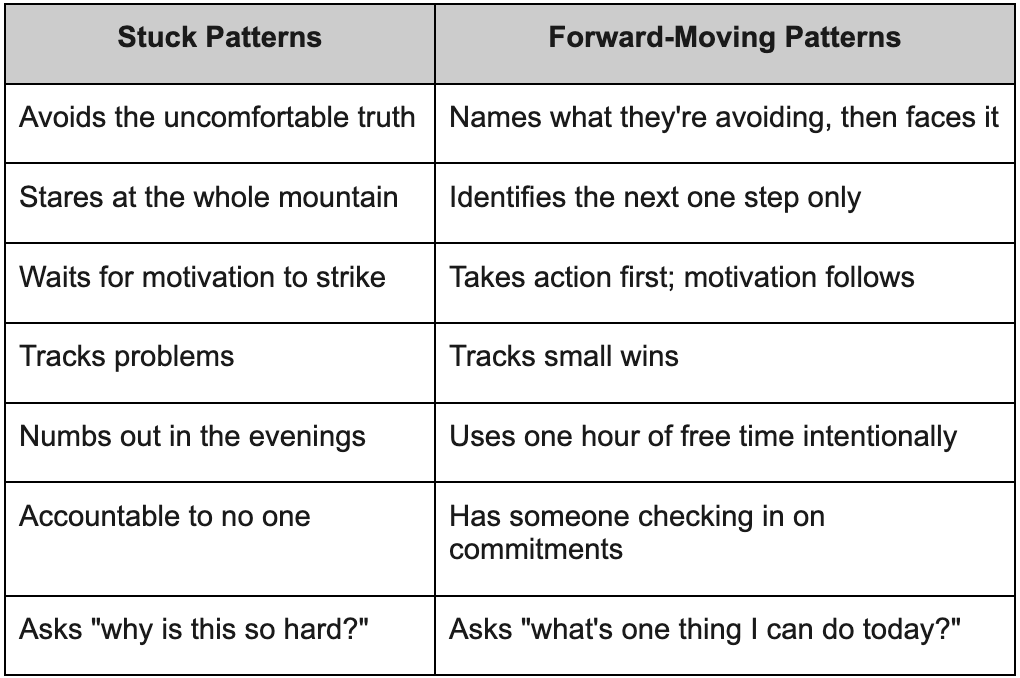
Stuck vs. Moving Forward: What's Actually Different
The difference between people who stay in ruts and people who don't isn't talent, luck, or opportunity. It's these daily patterns:
Key Takeaways
Getting out of a rut starts with naming what you're avoiding, not searching for motivation.
Break the overwhelming goal down to one step you can take today. Boring is fine. Boring gets done.
Win the day by committing to three concrete actions every morning. Momentum is built in small increments, not dramatic leaps.
Audit the habits that run your evenings. Your free time is either building the life you want or reinforcing the one you're in.
The plus-one/minus-one principle: every day you move forward or you don't. Those decisions compound.

Ready to Transform Your Life? Start With a Free Consultation
The most successful people don't wait for perfect conditions—they take action when they recognize an opportunity. If you've read this far, you're already considering whether coaching might be the catalyst you need to reach your next level of success and fulfillment.
Take the first step today by scheduling a free 60-minute consultation call with coach Jeff.
This is a no obligation call to see if coaching is right for you! Your future self will thank you for taking this crucial step today.

Frequently Asked Questions About Getting Out of a Rut
Why do I feel stuck even though my life looks fine on paper? Feeling stuck while being objectively successful is one of the most common patterns in career coaching. The problem usually isn't external circumstances; it's a growing misalignment between what you've built and who you actually are. "Fine on paper" often means you've been optimizing for the wrong scorecard.
How long does it take to get out of a rut? It depends on how long the rut has been building and how quickly you're willing to face what's driving it. In my coaching work, most clients start to feel movement within the first two to three sessions once they identify and act on what they've been avoiding. The rut itself can persist for years; getting out of it, once you start moving honestly, is usually faster than people expect.
Is feeling stuck in your career a sign you should change jobs? Not necessarily. Feeling stuck in your career can signal a job problem, a career problem, or a life problem. Many people change jobs and feel the same way six months later because they took the rut with them. The first step is identifying whether the stuckness is situational (this job, this boss, this company) or something deeper about the direction of your career entirely.
What's the difference between burnout and being in a rut? Burnout is primarily a depletion problem: you've given too much for too long and your system is running on empty. A rut is primarily a direction problem: you have energy, but it's going nowhere meaningful. They can overlap, but the distinction matters. Burnout needs rest and recovery first. A rut needs honest redirection. Treating one with the cure for the other doesn't work.
Can coaching actually help someone get out of a rut? Coaching can accelerate the process significantly because it creates two things most people lack when they're stuck: an external perspective and real accountability. Most people already know, somewhere, what they need to do. Coaching helps you surface that, build a plan around it, and follow through on it consistently rather than cycling through the same thinking alone. Learn more about working with a career and life coach.
What if I've been in this rut for years? The length of time you've been stuck doesn't determine how quickly you can start moving. It does determine how honest you'll need to be with yourself about what's kept you there. Long ruts usually have stronger avoidance patterns underneath them, which means the answer to Question 1 might be harder to write down. Write it down anyway.
About the Author: Jeff Rothenberg is a life and career coach and founder of A Path That Calls, based in Phoenix, Arizona. He holds a certificate in Applied Positive Psychology from the University of Pennsylvania and is certified in the Myers-Briggs Type Indicator. After 15+ years leading sales and operations teams at early-stage technology companies, including navigating his own career pivot, Jeff now helps professionals and young adults get unstuck and build careers aligned with who they actually are. He coaches clients in person in the Phoenix area and virtually nationwide. Learn more at here.

I’m Jeff Rothenberg, a personal growth and career coach helping people turn uncertainty into confidence and clarity. Whether you’re rebuilding after change, exploring your next career move, or simply ready to grow, I’ll help you create momentum that lasts.
