
The Energy Audit: Why You Keep Setting the Wrong Goals

Pull up your 2025 goals, or if you abandoned them by February, just recall what you promised yourself last January. Now think about 2024.
Notice something? Same themes. Different year. Same promise that "this time will be different."
Here's what I know from making over 1,000 hiring decisions and coaching mid-career professionals through burnout: You don't have a discipline problem. You have a diagnostic problem.
You're setting goals based on what should make you happy—bigger title, more money, external validation—while ignoring the fundamental question: What actually creates energy for me versus what drains it?
I call this the misalignment trap. You're not broken. You're not lazy. You're building goals on top of work that's fundamentally opposed to your natural wiring. It's like running Windows software on Mac hardware—no amount of effort makes it flow.
Most goal-setting advice starts with "What do you want to accomplish?" That's backwards. The right first question is: "What actually fuels me versus depletes me?"
That's what an energy audit reveals. And it's why most 2026 goals will fail by February because they're built on sand, not truth.
The Real Reason Your Goals Keep Failing
It's Not About Discipline
Every January, millions of people set goals. By February, 80% have abandoned them. The standard diagnosis: "I just need more discipline. I need better habits. I need more accountability."
Wrong.
In my experience scaling two tech companies from single-digit employees to hundreds of people, I learned this: The highest performers aren't the most disciplined. They're the most aligned.
When someone is doing work that matches their natural wiring, it doesn't look like discipline from the inside—it feels effortless. To everyone else, they look obsessed, driven, unstoppable. To them, they're just doing what comes naturally.
That's not motivation. That's alignment.
When someone is doing work that opposes their wiring, every day is a discipline battle. They need willpower to show up. They need motivation to push through. They're grinding against their own nature.
That's not a character flaw. That's misalignment.
The Misalignment Trap
Here's what I see constantly in my coaching practice:
Someone comes to me saying "I need accountability" or "I lack follow-through." We dig deeper using professional assessments—MBTI, CliftonStrengths, STRONG Interest Inventory. The pattern emerges: They've been forcing themselves toward goals that sound impressive but feel draining.
Here’s a real example: A client came to me after his second failed attempt at making partner at a Big 4 accounting firm. "I just need to work harder," he said. His assessments revealed he was wired as a builder and creator, not an auditor. He was trying to succeed in a role fundamentally opposed to his natural strengths.
Seven months later he's Head of Finance at a Series B startup. Making similar money. Working fewer hours. Actually excited for Monday mornings.
The difference? Alignment.
Every goal you set without understanding your energy economics is built on hope, not truth. And hope is not a strategy.
What An Energy Audit Actually Means
An energy audit isn't about time management or productivity hacks. It's diagnostic work that reveals:
What types of work consistently fuel you (and why)
What types of work consistently drain you (even when you're "good" at them)
Your natural wiring (the strengths that showed up effortlessly in childhood)
The gap between who you are and who you've been pretending to be
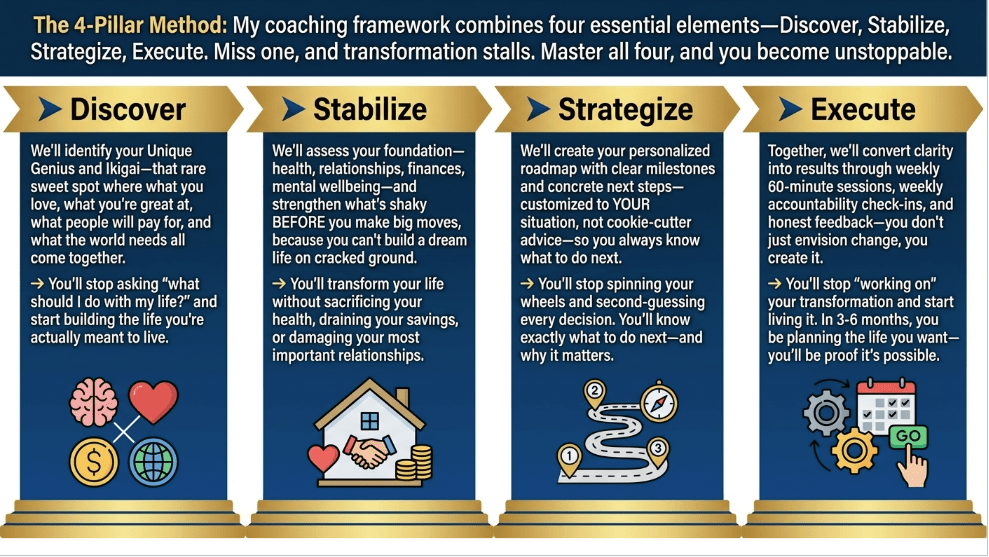
This is the foundation of my 4-Pillar Method for career transformation: You can't strategize where you're going until you discover who you actually are.
Strategy without self-knowledge is just expensive wandering.
The 5-Minute Version:
If you're skimming, here's what you need to know:
Most goals fail because of misalignment, not lack of discipline
An energy audit reveals what actually fuels versus drains you
The process: Review your calendar, answer 7 diagnostic questions, extract operating lists
Result: Foundation of truth for building 2026 goals that actually stick
Time required: 3-4 hours (or start with 90 minutes for the calendar review)

How to Run Your Own Energy Audit
Step 1: Create the Right Container
Block 3-4 uninterrupted hours this week. Actually block your calendar—not "I'll find time."
If that feels impossible right now, start with 90 minutes for just the Calendar Excavation (Step 2). That alone often reveals enough truth to change your trajectory.
Before you start, answer this question in writing:
"What am I afraid this energy audit will reveal about my current life and career?"
Write for 5 minutes. Don't edit. Just dump it.
This primes you for honesty instead of performance. Most people approach self-reflection like they're updating their LinkedIn profile—curated, polished, performative. We're going for uncomfortable truth.
Then: Get in a good physiological state. Move your body for 20 minutes. Hydrate. Change your physical environment—not your desk where you perform work, somewhere else where you can actually think.
Optional but powerful: Write 10-15 things you're genuinely grateful for from this year. Not accomplishments—moments, people, lessons, surprises. This shifts your nervous system from judgment to observation. You can't audit your year fairly from a state of shame.

Step 2: The Calendar Excavation
This is adapted from productivity research and what I've seen repeatedly over 15 years of watching what actually predicts career satisfaction versus burnout.
Pull up your calendar for all of 2025. Month by month, you're going to mark every recurring meeting, project, commitment, and activity with a simple code:
+ (Green): Net positive energy. You looked forward to it. Left feeling fueled.
- (Red): Net negative energy. You dreaded it. Left feeling depleted.
0 (Yellow): Neutral. Necessary but neither fueling nor draining.
Do this quickly. First instinct. Don't overthink.
What you're looking for:
Which activities were consistently green?
Which activities were consistently red?
Were the red activities frequent? (That's your burnout source.)
Were the green activities rare? (That's your unfulfillment source.)
Visual tip: If you use Google Calendar or Outlook, you can actually color-code events to see the patterns at a glance. It doesn't need to be pretty—it just needs to be honest. Green is energy; red is drain.
Here’s an example from my practice: A client realized his weekly team meetings (that he led) were always green. His 1:1s with his boss were always red. His quarterly board presentations were always green. His daily email management was always red.
Pattern revealed: He was a strategic communicator being forced into operational management. Wrong role. Right company.
Once we identified this, he negotiated a role restructure within 90 days. Same company. Different responsibilities. Completely different energy.
Step 3: The Seven Diagnostic Questions
Now answer these questions in writing. One paragraph each. No editing for grammar—just truth.
Question 1: What created consistent energy for me this year?
Which people? Which projects? Which types of problems?
When did I lose track of time in a good way?
What would I do even if I wasn't paid?
Question 2: What consistently drained my energy this year?
Which people? Which meetings? Which types of work?
What did I procrastinate on repeatedly?
What made Sunday nights feel heavy?
Question 3: What activities from childhood came effortlessly that I've abandoned as an adult?
This is critical. Your hardwired strengths show up early, before you learned what you "should" be good at.
Did you organize neighborhood events? Build things? Teach friends? Solve puzzles? Lead games?
These aren't hobbies—they're clues to your natural wiring.
If childhood feels too far away or too complicated, look at your early career. What was the very first work task where you thought, "I can't believe people get paid to do this—this is actually fun"?
Question 4: What goals did I set in 2025 that I completely ignored?
List them honestly.
For each one, ask: Did I ignore this because I'm undisciplined, or because it was misaligned with who I actually am?
Most "failed" goals are your subconscious protecting you from becoming someone you're not.
Question 5: What did I not do this year purely because of fear?
What conversation? What pivot? What risk?
Was the fear rational (genuine danger) or protective (keeping you comfortable in misalignment)?
Question 6: If I could design my perfect Tuesday—no constraints—what would it look like?
Where would I be? What problems would I solve? Who would I work with?
How much would be collaborative versus solo? Strategic versus tactical? Creative versus analytical?
This reveals what you're actually wired for.
Question 7: What story am I telling myself about why I can't change?
"I'm too old." "I have a mortgage." "I'm not qualified." "The market is bad."
Write the story. Then ask: Is this true, or is this a boat anchor keeping me safe but stuck?

Step 4: Extract Your Operating Lists
From your answers above, create these lists. These become your foundation for 2026 planning.
Energy Creators (Top 10):
People, activities, projects, environments that consistently fueled you
Goal for 2026: Do dramatically more of these
Energy Drainers (Top 10):
People, activities, projects, environments that consistently depleted you
Goal for 2026: Eliminate, delegate, redesign, or tightly contain these
Your Not-To-Do List:
Pull every red (-) item from your calendar review
These are activities you commit to NOT doing, reducing, or redesigning in 2026
Make this list visible. Pin it to your wall. This is more valuable than your to-do list.
Wiring Clues:
What patterns emerged from your childhood effortless activities?
What types of problems do you solve naturally?
What's your energy signature? Strategic versus tactical? People versus systems? Building versus optimizing?
Boat Anchors:
What stories, commitments, or identities are keeping you stuck?
Which ones are you willing to release?
Step 5: The Uncomfortable Question
Based on this energy audit, answer honestly:
"Am I in the right role/company/career path, or am I trying to force-fit myself into someone else's definition of success?"
You don't need to have the answer yet. But you need to ask the question.
If the honest answer is "I'm fundamentally misaligned," that's not failure—that's diagnostic clarity. Now you know what you're actually solving for.
If the honest answer is "I'm mostly aligned but some things need adjustment," that's also clarity. Now you know what to optimize.
Either way, you're building 2026 on truth instead of hope.

What This Energy Audit Actually Reveals
Pattern Recognition You Can't See While You're Living It
When you're in the middle of your year, you can't see the patterns. You're just surviving meeting to meeting, project to project, crisis to crisis.
The energy audit creates distance. It lets you see:
The 20% of activities generating 80% of your fulfillment (and whether you're actually prioritizing them)
The hidden energy drains (the commitments that seemed small but cumulatively killed your capacity)
Your misalignment symptoms (procrastination, Sunday dread, chronic fatigue despite adequate sleep)
Your alignment evidence (the work where time disappeared, where you felt competent, where impact came naturally)
This gives you real evidence. Not just feelings or wishes. Actual proof of what works for you versus what doesn't.
Why Most People Skip This Step (And Pay For It)
Here's what happens when you skip the energy audit and go straight to goal-setting:
You set goals based on:
What worked for someone else
What sounds impressive to others
What you think you "should" want
What you failed at last year (and assume you just need more discipline)
Then February hits. The goals feel heavy. The motivation fades. The discipline wavers.
You blame yourself for lacking follow-through.
The real problem? You were building on misalignment from day one.
The energy audit prevents this. It gives you a foundation of truth. Then when you set goals (which I'll cover in next week's post), they're aligned with your actual wiring—not your aspirational self-image.

What Comes Next
The energy audit is the foundation. It's diagnostic, not prescriptive.
Next week, I'll show you how to take these insights and build 2026 goals that actually stick—even when you're burned out, even when you're questioning your entire path, even when February hits.
We'll cover:
The Two-Lane Strategy (stabilize first, then strategize)
How to set goals when you're fundamentally misaligned
Anti-Goals (what you refuse to sacrifice)
The Tiered Reliability System (how to maintain momentum on bad days)
But none of that works without the energy audit. You can't build a cathedral on quicksand.
So before you do anything else: Block the time. Do the work. Get the clarity.

Ready to Transform Your Life? Start With a Free Consultation
The most successful people don't wait for perfect conditions—they take action when they recognize an opportunity. If you've read this far, you're already considering whether coaching might be the catalyst you need to reach your next level of success and fulfillment.
Take the first step today by scheduling a free 60-minute consultation call with coach Jeff.
This is a no obligation call to see if coaching is right for you! Your future self will thank you for taking this crucial step today.

Frequently Asked Questions
What is an energy audit, exactly?
An energy audit is a structured reflection process that helps you identify what work, people, and activities consistently fuel you versus drain you. Unlike traditional goal setting, it’s diagnostic — not aspirational. The goal isn’t to decide what you should want next year, but to uncover patterns that reveal how you’re actually wired, so future goals are built on truth instead of hope.
How is an energy audit different from goal setting or productivity planning?
Most goal-setting frameworks start with outcomes: “What do I want to achieve?”
An energy audit starts with evidence: “What actually worked for me, and what didn’t?”
Productivity systems try to optimize behavior. An energy audit diagnoses alignment. If your goals are misaligned with your natural wiring, no habit tracker or accountability system will save them. The audit ensures your goals are pointing in the right direction before you worry about execution.
How long does an energy audit take?
A full energy audit takes 3–4 hours, ideally in one or two focused sessions.
If that feels like too much right now, start with 90 minutes for the calendar review alone. Many people gain immediate clarity just from identifying which recurring activities consistently drained or fueled their energy.
This is foundational work — not busywork.
Who is an energy audit best suited for?
An energy audit is especially valuable if you are:
A mid-career professional feeling burned out or disengaged
Repeating the same goals every year with little follow-through
Questioning whether your current role or career path still fits
Successful “on paper” but increasingly drained
Considering a career transition but unsure where to pivot
If you feel stuck but not broken, this process is designed for you.
Can an energy audit help with burnout or career transitions?
Yes. Burnout is often a misalignment problem, not a resilience problem. An energy audit helps you identify whether burnout is coming from:
The wrong role
The wrong responsibilities
The wrong environment
Or the wrong career direction
Once you see the pattern, you can make targeted changes instead of vague resolutions to “work less” or “try harder.”
What should I do after I complete the energy audit?
After completing the audit, don’t jump straight into ambitious goal setting.
The next step is translating insight into strategy:
Stabilizing what’s draining you
Designing goals aligned with your energy
Defining anti-goals (what you refuse to sacrifice)
Building systems that work even on bad weeks
That’s exactly what the next article in this series covers: how to build goals that actually stick after burnout or misalignment.

I’m Jeff Rothenberg, a personal growth and career coach helping people turn uncertainty into confidence and clarity. Whether you’re rebuilding after change, exploring your next career move, or simply ready to grow, I’ll help you create momentum that lasts.
