
You Will Be Dust in 150 Years. So Why Are You Still Playing It Safe?

TL;DR: Most people wait for a crisis, a diagnosis, or a hospital waiting room to get honest about what they actually want. You don't have to. Deliberately reflecting on your own mortality, what psychologists call mortality salience, consistently shifts people away from chasing status and toward purpose, connection, and meaning.
The single most clarifying question a career coach can put in front of you is this: if you had five years left, what would you change?
I was sitting in a hospital waiting room a few years back. Fluorescent lights, bad coffee, CNN on mute. Somebody I cared about was on the other side of those double doors, and I didn't know if they were going to be okay.
In that moment, every single thing I'd been stressed about that week disappeared. The work stuff. The inbox. The meetings. The nonsense I'd been losing sleep over. Gone.
The only things left were the ones that actually mattered. The people I loved. Whether I'd told them enough. Whether I'd been present. Whether I'd been living the kind of life I'd want to look back on.
That's what proximity to death does. It strips everything fake away and leaves you standing with the truth. And the truth is almost always simpler, and scarier, than whatever you've been telling yourself.
I think about that day a lot. Not because I enjoy it. Because it was one of the most clarifying moments of my life. And I've come to believe that deliberately thinking about your own mortality, something most people avoid at all costs, is one of the most useful things you can do for your career, your relationships, and your sense of purpose.
Why Do Successful People Still Feel Stuck?
The people I work with as a career coach in Phoenix are, by most external measures, doing fine. They have stable jobs, decent incomes, maybe a title they worked hard for. They're not in crisis. They're just quietly miserable.
What keeps them stuck isn't a lack of skills or opportunity. It's a quiet but persistent fear of the unknown paired with a very human tendency to overvalue what they already have, even when it's making them unhappy. Psychologists call this status quo bias: the current situation, even a bad one, feels safer than change because at least you know what it looks like. I call this the comfort prison.
Add the gravitational pull of a good salary, benefits, and what other people expect from you, and staying put starts to feel like the rational choice. It isn't. It's just the familiar one.

What Does the Research on Mortality Awareness Actually Say?
The ancient Stoics had a practice called Memento Mori. Latin for "remember, you will die." Roman generals had servants whisper it to them during victory parades. Not to ruin the moment. To sharpen it. To remind them that the glory, the power, and the applause are temporary. Use them while you have them.
Steve Jobs made the same point in his 2005 Stanford commencement address, which has been viewed more than 120 million times. He said that remembering he would be dead soon was the most important tool he had ever encountered for making the big choices in life. External expectations, pride, fear of embarrassment, he said, all of it falls away in the face of death, leaving only what is truly important.
He said that after a cancer diagnosis. It took a life-threatening illness for one of the most successful people on the planet to figure out what actually mattered. Most people have the chance to figure it out without the diagnosis. Most don't take it.
The psychological research backs this up. More than three decades of studies in Terror Management Theory have found that when people deliberately reflect on their own mortality, consciously and intentionally rather than in a panic, they shift. They move away from chasing status and money and toward growth, connection, and meaning. They make decisions that align with who they are rather than who they think they're supposed to be.
The paradox is real: thinking about death doesn't make people more afraid. It makes them more alive.

What Do People Regret Most at the End of Their Lives?
A palliative care nurse named Bronnie Ware spent years sitting with patients in their final weeks and documented what they said they regretted. Her writing on the topic was read by millions and later developed into a book. The same five themes came up again and again.
The number one regret: "I wish I'd had the courage to live a life true to myself, not the life others expected of me."
Read that again. Not "I wish I'd worked harder." Not "I wish I'd played it safer." The exact opposite.
The rest of the list hits just as hard:
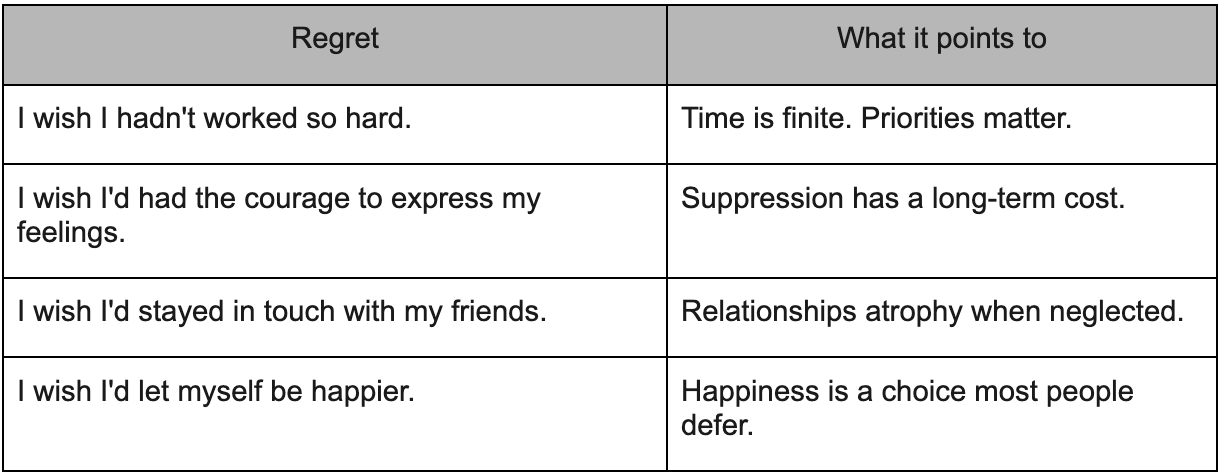
Every regret on that list is about something they didn't do. Not something they did. Nobody on their deathbed says they're glad they stayed in the soul-crushing job because the health insurance was good.
In my work as a life and career coach, I see this pattern often. Talented, capable people, in Phoenix, in Scottsdale, and working with me virtually from across the country, who know they want something different but can't give themselves permission to go after it. Permission to want more. Permission to fail. Permission to decide that their current unhappiness is not a life sentence.

Why Do We Stay Stuck Even When We Know Better?
Let me be honest with you. I know what stuck feels like. I've lived it.
I spent years in corporate America doing what I thought I was supposed to do. Climbing the ladder, chasing titles, hitting numbers. I was good at it. Over 15 years, I was promoted more than ten times across six companies. I built teams, ran operations, drove revenue across sales, customer success, and underwriting.
But there were mornings I'd sit in my car in the parking lot before going in and think: is this it? Is this what the next 20 years look like?
I'd push that thought down and go inside and get to work. Because that's what you do, right? Bills. Responsibilities. A mortgage. An identity built around the life you're currently living. So you push the feeling down and tell yourself you'll figure it out later.
Later. That's the most dangerous word in the English language when it comes to your own life.
Here's what the research and my own coaching experience both point to: we overvalue the known and undervalue the unknown. We tell ourselves the constraints are real when most of the time, after doing the actual work of examining them, the real constraint is fear. Fear of failure, fear of judgment, fear of finding out we're not good enough. Name the fear, and it loses most of its power.

What Does "Going For It" Actually Look Like for a Real Person?
I want to be practical here, because I know how inspirational content can land. You read something, you feel fired up for 20 minutes, and then you go back to exactly what you were doing before. That's not what I want for you.
So here's what going for it actually looks like when you have real responsibilities:
First, get honest about what you actually want. Not what you think you should want. Not what looks good on LinkedIn. What would you do if money weren't a factor and judgment didn't exist? I ask this in the first session with nearly every client I work with as a career coach and a life coach. Most people can't answer it immediately. Not because the answer doesn't exist, but because they buried it so long ago they forgot where they put it.
Second, figure out what's actually holding you back versus what you're telling yourself is holding you back. Most people say "I can't because of money" or "I can't because it's too late." Sometimes those are real constraints. But when we actually examine them, the real blocker is almost always fear. Once you name it, you can work with it.
Third, take one step. Not ten. One. Update the resume. Have the conversation. Sign up for the course. The antidote to anxiety is action. It always has been and I say that line so much with my coaching clients they’re probably sick of it but it’s true. You don't need the whole plan figured out. You just need the next move.
I think about this through what I call the plus-one/minus-one framework: every decision you make is either a plus-one toward the life you want or a minus-one away from it. And those small decisions compound. Every day you stay in a situation you've outgrown is a minus-one. Every small step toward something more aligned is a plus-one. Over months and years, those add up to either a life you're proud of or a list of regrets.

Key Takeaways
Deliberately reflecting on your own mortality (Memento Mori) is a well-documented psychological tool that shifts people from status-chasing toward purpose and meaning.
Research on end-of-life regrets consistently shows the same pattern: people regret what they didn't do, not what they tried.
Status quo bias is real: your brain makes the familiar option feel safer than the unknown, even when the familiar option is making you miserable.
The real barrier to change is almost never the practical constraint you cite. It's the fear underneath it. Name the fear.
The plus-one/minus-one framework: every decision either moves you toward the life you want or away from it. Small decisions compound in both directions.
Frequently Asked Questions
Does thinking about death actually change how people make decisions?
Research in Terror Management Theory, built on more than 30 years of studies, shows that when people consciously reflect on their mortality in a deliberate rather than panicked way, they consistently shift toward prioritizing meaning, connection, and growth over status and external validation. The shift is measurable and well-documented in the psychological literature.
What is Memento Mori and how is it relevant to career decisions?
Memento Mori is a Latin phrase meaning "remember, you will die." It was practiced by ancient Stoic philosophers and Roman leaders as a reminder that time is finite and should be used intentionally. In a career context, it functions as a clarifying filter: would you stay in this situation if your time were clearly limited? That question tends to cut through the noise faster than most frameworks.
What do most people regret at the end of their lives?
Based on the well-documented observations of palliative care nurse Bronnie Ware, the most common regret is not having lived a life true to oneself rather than the life others expected. Other top regrets include working too hard, not expressing feelings honestly, losing touch with friends, and not allowing more happiness. Notably, all of the most common regrets are about things people didn't do.
What is the plus-one/minus-one framework?
It's a decision-making tool I use in my coaching practice. Every choice you make is either a plus-one, moving you toward the life you want, or a minus-one, moving you away from it. The framework isn't about big dramatic decisions. It's about recognizing that small daily choices compound over time, and that staying stuck is itself a decision that accumulates its own cost.
How does a career coach help someone who feels stuck but doesn't know what they want?
The first step in most of my coaching engagements is helping clients reconnect with what they actually want, separate from what they think they should want or what other people expect from them. That often means examining long-buried interests, running strengths and values assessments, and doing the honest work of naming what's really holding them back. Clarity usually comes from doing this work in structured conversation, not from thinking harder alone.
Is it too late to change careers or make a major life change if you're in your 40s or 50s?
In my experience working with mid-career and later-stage professionals in Phoenix and Scottsdale and virtually nationwide, the answer is no. The practical constraints are real and deserve honest assessment, but they're rarely the actual barrier. The perception that it's "too late" is almost always a story, not a fact. The next best time to start is now.

Ready to Transform Your Life? Start With a Free Consultation
The most successful people don't wait for perfect conditions—they take action when they recognize an opportunity. If you've read this far, you're already considering whether coaching might be the catalyst you need to reach your next level of success and fulfillment.
Take the first step today by scheduling a free 60-minute consultation call with coach Jeff.
This is a no obligation call to see if coaching is right for you! Your future self will thank you for taking this crucial step today.
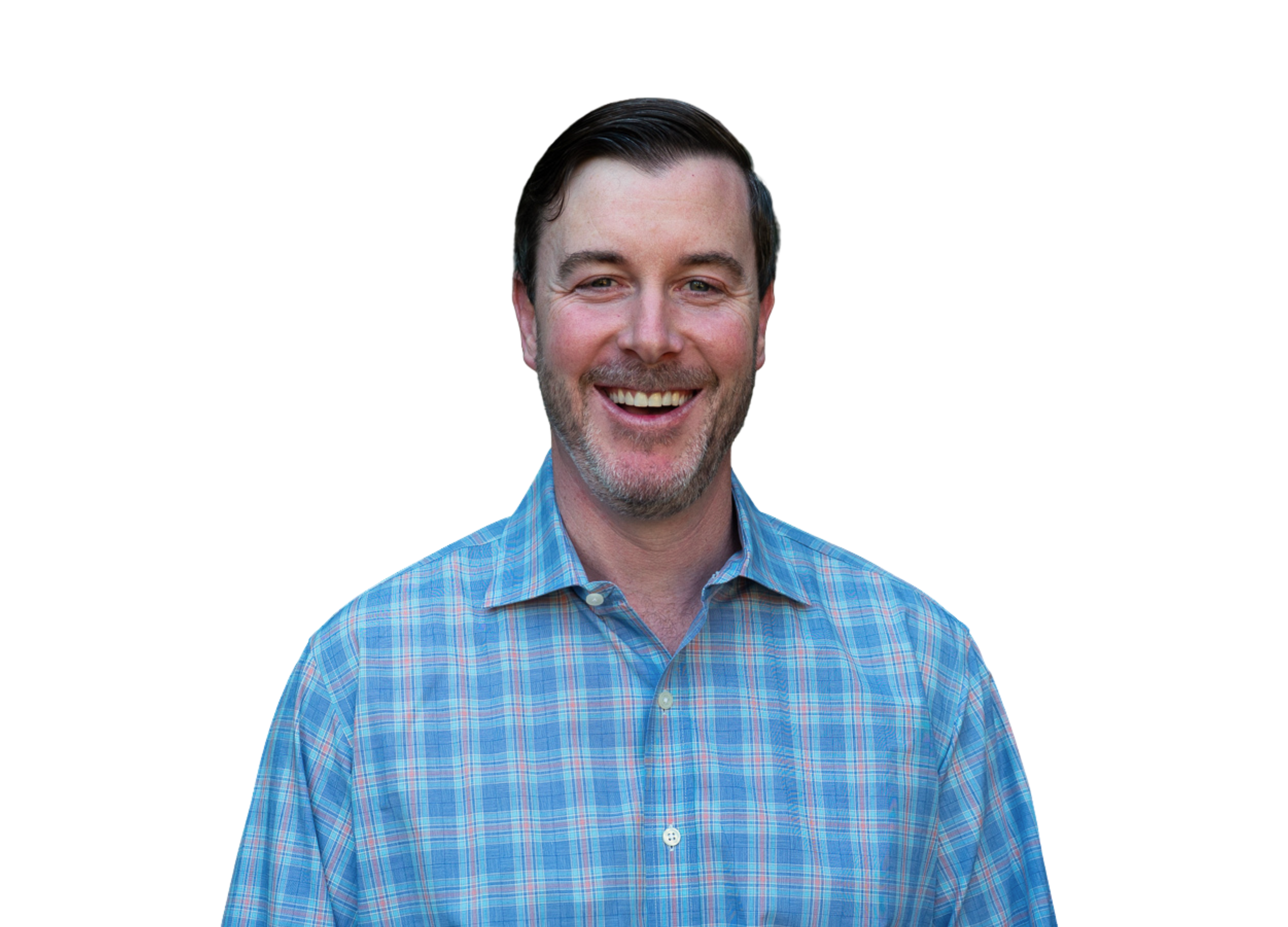
Jeff Rothenberg is the founder of A Path That Calls and a life and career coach based in Phoenix. After 15+ years in sales and operations leadership at early-stage technology companies, including multiple exits and more than ten promotions across six organizations, he left corporate America to help professionals do the work he wished he'd done sooner. He holds certifications in Applied Positive Psychology from the University of Pennsylvania and is trained in Myers-Briggs assessment. He coaches clients in Phoenix and Scottsdale in person and virtually nationwide. Learn more at apaththatcalls.com.

I’m Jeff Rothenberg, a personal growth and career coach helping people turn uncertainty into confidence and clarity. Whether you’re rebuilding after change, exploring your next career move, or simply ready to grow, I’ll help you create momentum that lasts.
