
You’re Probably Not Lazy. You’re Probably Misaligned.

TL;DR: Career misalignment is the gap between who you are and what your work requires. It's a fit problem, not an effort problem.
High achievers are often the last to recognize misalignment because they compensate with effort, and the output holds long after the internal experience has deteriorated.
The costs spread beyond work: depleted energy at home, relational friction, and a slow erosion of the things that matter outside the office.
The Fit Audit (Energy Ledger, Flow Inventory, Friction Map), developed by Jeff Rothenberg, is a structured way to locate where misalignment lives before making any decisions.
Realignment is a strategy, not a fantasy. It requires a structured process built on real data about who you are, not an impulsive quit.
Career misalignment means your values, strengths, or working style are in consistent conflict with what your job requires. It is one of the most common causes of burnout that most people never correctly identify. When the fit is wrong, your energy depletes even when the workload seems manageable, motivation disappears even when you try, and no amount of discipline fixes the underlying problem. The fix isn't more effort. It's better alignment.
The people I work with most often are not failing. They're performing. They're hitting targets, getting decent reviews, keeping up with email. From the outside, nothing looks wrong. From the inside, they're running on fumes, and most of them have quietly started to wonder if they're burned out, misaligned, or just broken in some way they can't name.
That gap between what looks fine and what feels depleted is the thing I spend most of my coaching time on. And the explanation almost everyone arrives at first is the wrong one. They think they're lazy. They think they've lost their drive. They think something has gone wrong with them personally.
Most of the time, none of that is true. What's actually happening is a fit problem. And fit problems don't get better with more effort. They get worse.
What Does 'Career Misalignment' Actually Mean?
Career misalignment is the gap between who you are and what your work requires of you. It's when your values, your natural strengths, or the way you do your best thinking are in consistent conflict with what the role, the organization, or the industry demands: day after day, week after week.
Laziness is an effort problem. Misalignment is a fit problem. They look identical from the outside. From the inside, they feel completely different.
A gifted surgeon who'd rather be designing buildings isn't lazy for struggling to care about medicine. A creative strategist stuck in a compliance-heavy bureaucracy isn't lazy for going flat. Neither is the person who comes home every night with nothing left for their kids, short-tempered and half-present, wondering why they can't just leave work at work. The work itself isn't always the problem. The fit is.
Misalignment burnout happens when you consistently operate in environments that run counter to your core values and natural working style. The energy cost of compensating for that conflict accumulates quietly. Over time, it looks a lot like apathy.
The Energy Test: A Simple Diagnostic
Think about the last time work actually felt easy. Not effortless because it was simple, but easy because you were in the right gear: the kind of absorbed focus where you look up and two hours have gone by. What were you doing? What kind of problem were you solving?
Now think about what you've spent most of the past month doing. If those two lists barely overlap, you're probably looking at a misalignment problem, not a motivation problem.
Gallup's research on strengths consistently shows that employees who spend the majority of their time on work that uses their natural strengths end the day with more energy, not less. The inverse is also true: spending most of your workday on work that conflicts with your strengths, regardless of effort, is a reliable path to depletion.

Why High Achievers Are Often the Last to Notice
The harder you work to compensate for misalignment, the longer it stays invisible.
High achievers are exceptionally good at doing things they don't want to do. That's part of what made them high achievers. They push through, figure it out, meet the deadline even when everything in them is resisting. This is a real skill. It's also the skill that lets misalignment hide for years.
I've worked with people who spent a decade performing at a high level in a role that was quietly hollowing them out. Not because they weren't paying attention. Because they were too good at pushing through to notice the bill coming due.
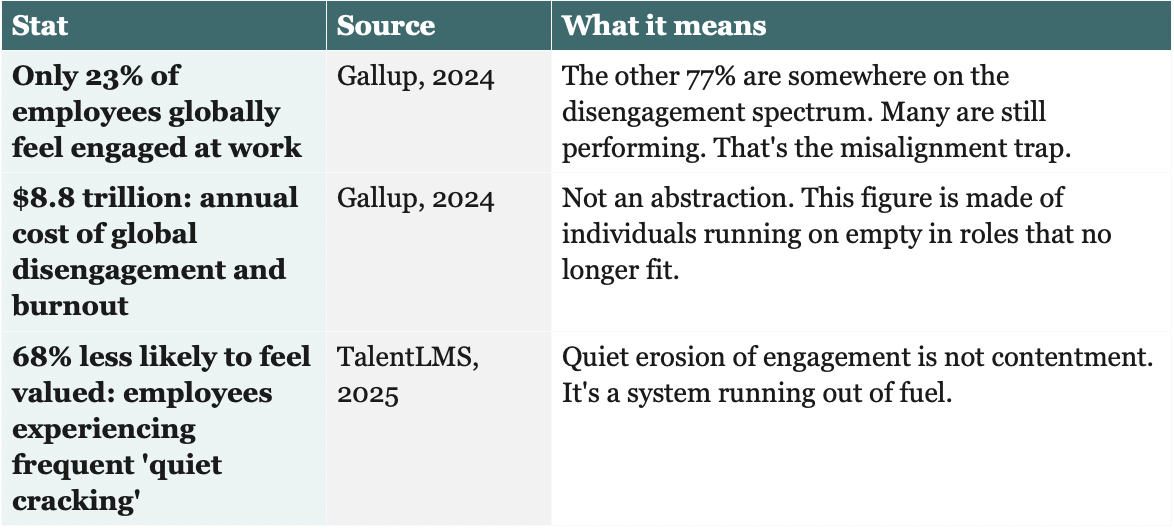
Gallup's 2024 State of the Global Workplace report reflects this at scale: only 23% of employees globally feel engaged at work. The remaining 77% are disconnected or actively disengaged. But many of the disengaged aren't underperforming. They're overperforming on work that no longer fits.
The Mask of Productivity
Misaligned high achievers often receive the most positive external feedback at precisely the moment their internal alignment is at its worst. You get the review. You close the deal. You're told you're crushing it. And you feel nothing, or worse: you feel like a fraud.
The output keeps coming, but the signal underneath (the one saying this is not right) gets buried under the praise. That gap between external success and internal experience is one of the most reliable early indicators of deep misalignment.
Research on what's been called 'quiet cracking,' the slow involuntary erosion of workplace engagement, puts a number to this: employees who frequently experience this kind of disengagement are 68% less likely to feel valued and recognized at work (TalentLMS, 2025). The silence isn't contentment. It's a system running out of fuel.

Signs You're Misaligned (Not Lazy)
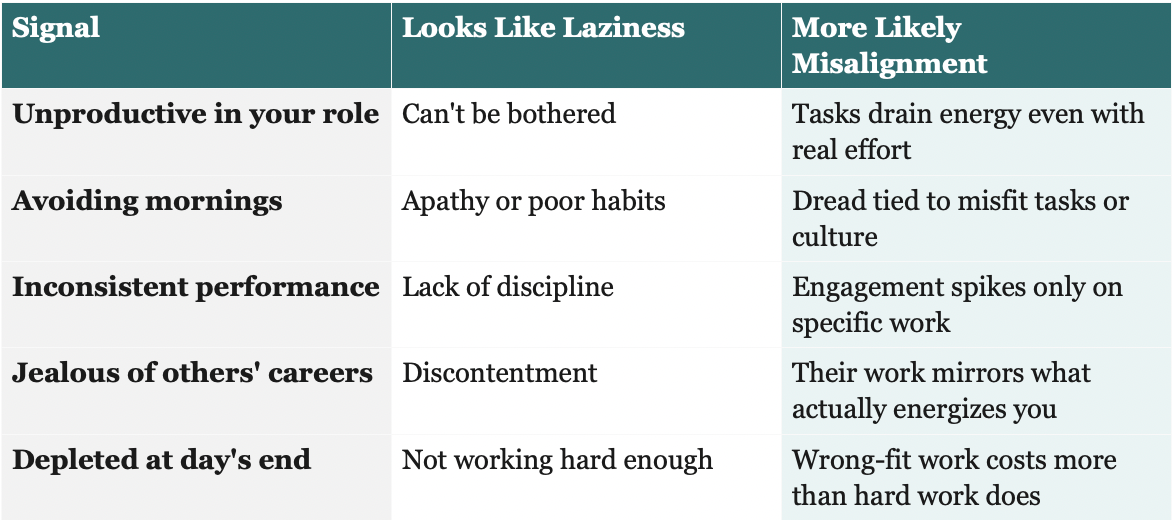
Misalignment reveals itself in patterns over time, not in a single bad week. Look for clusters of these:
You feel exhausted after work that should be easy. Not tired from effort, but depleted out of proportion to what you actually did.
You're productive but joyless. The work gets done; you can't access satisfaction from it.
You feel pointed envy toward people doing entirely different work. Not their salary, but what they're actually doing with their days.
Sunday evenings trigger dread that goes well beyond normal pre-week reluctance.
You've started resenting your title or your industry in ways that feel disproportionate.
Your motivation spikes sharply when you imagine doing something else, even something impractical or undefined.
You perform inconsistently. Pockets of real energy exist, but they're tied to specific types of tasks, not to how hard you're trying.
The table below maps what these patterns look like through both lenses:
What Misalignment Actually Costs You
The cost isn't just professional. It spreads.
At work, even strong performers eventually see output decline. Creativity dries up. Decision-making slows. You start doing the minimum version of things you used to care about.
At home is where the damage is harder to measure. The energy spent compensating for misfit work comes from your capacity to be present with the people you love, maintain your health, have anything left for the things that restore you. Misalignment follows you home, and it usually takes a while to realize how much.
The version of this I see most often: someone who is technically fine on paper (good income, stable job, respected at work) but who has slowly become a different person at home. Shorter. Less present. Their partner has noticed. They've noticed. Nobody has named it yet.
Realignment Is a Strategy, Not a Fantasy
One of the most common objections: 'I have a mortgage. I can't just quit. I don't know what else I'd do.'Realignment isn't quitting on impulse or following your passion off a financial cliff. It's a systematic process of figuring out where fit actually lives and building a real path toward it.
The process I use with clients runs through four phases: Discover (identifying actual strengths, values, and working style), Stabilize (ensuring structural foundations can support a change before making one), Strategize (building a concrete plan), and Execute (taking grounded action with ongoing support). No phase is optional.
Skipping Discover means optimizing for the wrong target. Skipping Stabilize is how good career decisions turn into financial emergencies.Professional assessments (CliftonStrengths, the MBTI, the STRONG Interest Inventory, VIA Character Strengths) are useful in the Discover phase, not because they hand you an answer, but because they surface patterns you've been too close to see clearly.For more on how this process works, see how I work with career transition clients, or learn about the life coaching work I do with people navigating exactly this kind of inflection point.

What to Do Next: The Fit Audit
When I work with a new client who suspects misalignment, one of the first things we do together is what I call the Fit Audit, a three-part diagnostic framework I developed from working with mid-career professionals navigating exactly this problem. You can begin the first two parts on your own.
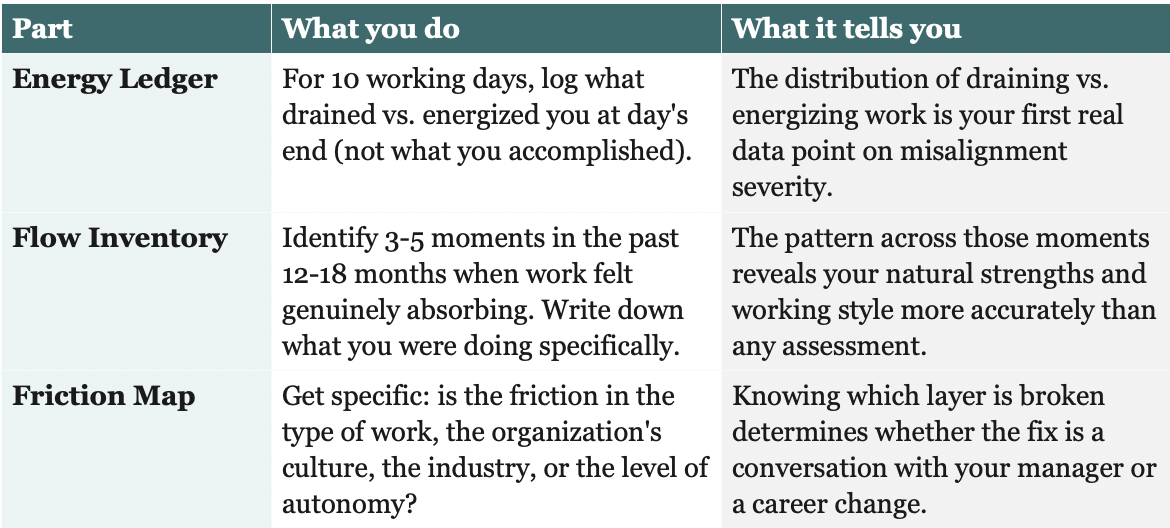
Part 1: The Energy Ledger.
For the next 10 working days, take 90 seconds at day's end and write down what drained you and what energized you. Not what you accomplished. Not what was hard. What left you depleted versus more alive. After 10 days, look at the distribution. Most people are surprised by how lopsided it is.
Part 2: The Flow Inventory.
Identify three to five moments in the past 12 to 18 months when work felt genuinely absorbing: the kind of focus where you didn't check your phone, where time moved differently. Write down what you were doing, what problem you were solving, and what the environment looked like. Not what you were proud of. What you were lost in.
Part 3: The Friction Map.
Get specific about where the misalignment lives. Is it the type of work itself? The organization's culture or values? The industry? The level of autonomy? The people? Knowing which layer is broken determines whether the fix is a conversation with your manager or something more fundamental. Most people skip this step and either stay stuck or make a change that doesn't fix the real problem.
If you want to do this work with real structure and support, the kind that translates into a concrete decision and a plan, that's exactly what working with a career coach makes possible.
Ready to Transform Your Life? Start With a Free Consultation
The most successful people don't wait for perfect conditions—they take action when they recognize an opportunity. If you've read this far, you're already considering whether coaching might be the catalyst you need to reach your next level of success and fulfillment.
Take the first step today by scheduling a free 60-minute consultation call with coach Jeff.
This is a no obligation call to see if coaching is right for you! Your future self will thank you for taking this crucial step today.

Frequently Asked Questions
What is career misalignment?
Career misalignment is the gap between who you are (your values, natural strengths, and working style) and what your job actually requires day to day. It's a fit problem, not a character flaw, and fit problems need different solutions than motivation problems.
How do I know if I'm burned out or misaligned?
Overwork burnout tends to improve with rest. Misalignment burnout doesn't: you come back from vacation and still dread Monday. If the exhaustion is tied to the nature of your work rather than the volume of it, misalignment is the more likely cause. The distinction matters because the interventions are different.
Can career misalignment cause physical symptoms?
Yes. Chronic misalignment is a sustained form of stress. It can show up as fatigue, poor sleep, frequent illness, and depletion that rest doesn't resolve. These are signals worth taking seriously.
Is career misalignment the same as burnout?
They overlap but aren't identical. Burnout can result from overwork, toxic culture, or under-resourcing. Misalignment is a specific driver of burnout rooted in values and fit conflict. The two frequently converge over time.
Do I need to quit my job if I'm misaligned?
Not necessarily. Misalignment lives on a spectrum. Sometimes role redesign or a team change is enough. Sometimes the misalignment runs deep enough that a career change is the clearest path. A structured process (not a snap decision) is how you tell the difference.
What does a career coach do for someone dealing with burnout or misalignment?
A career coach helps you identify the root cause of your dissatisfaction, clarify what you actually want, and build a realistic plan for getting there. The goal is clarity and a concrete strategy. Most clients find the diagnostic phase alone changes how they understand what's happening.

I’m Jeff Rothenberg, a personal growth and career coach helping people turn uncertainty into confidence and clarity. Whether you’re rebuilding after change, exploring your next career move, or simply ready to grow, I’ll help you create momentum that lasts.
