
AI Is Changing White-Collar Work. Here’s How to Build a Career That Gets More Valuable.
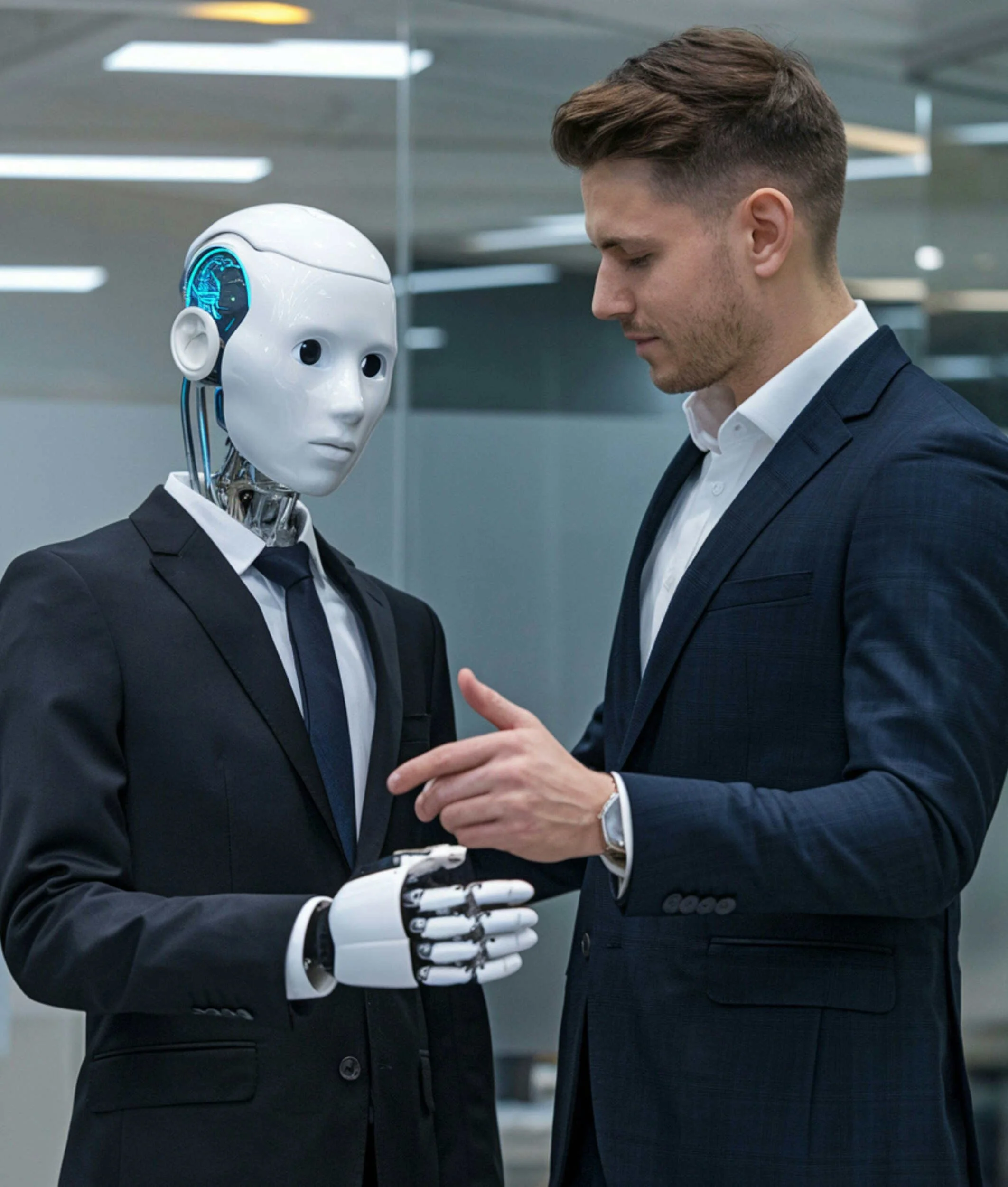
For the last few years, artificial intelligence could think. It could write, summarize, research, analyze, code, and advise. But humans still owned the last mile.
Someone still had to log into Salesforce, update the spreadsheet, send the follow-up, move information from one system to another, and take the output from AI and actually finish the work.
That barrier is beginning to fall.
On August 11, 2026, xAI introduced Grok Bot, a new kind of AI teammate that can use computers and software tools, work across applications, learn workflows, and complete tasks end to end. That distinction matters because once AI moves from helping someone perform a task to actually owning the workflow, the conversation about AI and the future of work changes.
The question is no longer simply, “How can AI make employees more productive?”
Companies can increasingly ask, “Which parts of this work still need to belong to a human at all?”
That is a much bigger question.
And if you’re thinking about your career right now—whether you’re 22, 42, or 62—I think it’s a question worth taking seriously. Not because there is no future for human work. There is. But I believe the future is going to reward a different kind of human.
The Unit of White-Collar Work Is Beginning to Change
For most of modern corporate history, companies have purchased labor by hiring people. You hire an analyst, a recruiter, an accountant, a salesperson, a developer, or an operations specialist. Then you assemble those people into departments because complicated work has to move between them.
But look closely at many white-collar jobs and you’ll discover that they’re really collections of workflows.
Pull the report. Research the account. Prepare the presentation. Schedule the meeting. Update the CRM. Reconcile the numbers. Write the first draft. Coordinate the project. Respond to routine questions. Move information from one place to another.
For decades, the person was the smallest practical unit a company could hire to perform those workflows. AI agents may begin changing that. The unit of white-collar labor could increasingly shift from the person to the workflow.
That doesn’t mean entire occupations disappear tomorrow. It means companies gain another option. Instead of asking, “Who should we hire to do this?” they can increasingly ask, “Can software own this?”
That is the phase shift I think people should be paying attention to.
The Biggest AI Job Disruption May Be Surprisingly Quiet
When people imagine AI replacing jobs, they often picture mass layoffs. I don’t think that’s necessarily how much of the disruption will happen.
It may be quieter.
Someone leaves a company, and the company doesn’t replace them. A department that once would have hired eight people hires four. A manager uses AI agents rather than requesting another coordinator. A senior analyst handles the difficult exceptions while AI completes the recurring work underneath them. A founder builds a company with six people that once would have required thirty.
The company grows. Revenue grows. The work still gets done. But the additional jobs simply never appear. Those missing jobs don’t show up in a layoff announcement. They simply never get posted.
And early-career roles may deserve particular attention. For generations, careers have worked partly because organizations gave young employees relatively structured work. You learned to pull the analysis before you learned to decide what the analysis meant. You prepared the presentation before you presented it to the executive team. You coordinated the project before you owned the strategy.
You performed smaller tasks until someone trusted you with bigger decisions. If AI absorbs more of those structured tasks, companies aren’t just automating work. They may also be disrupting the traditional career ladder that taught people how to become senior employees.
I think that is one of the most important questions companies, universities, parents, and young professionals are going to have to wrestle with.

Stop Looking for an AI-Proof Career
Whenever I talk about AI with career coaching clients, one question eventually comes up: “What careers are safe from AI?” I understand why people ask it. But I increasingly think it’s the wrong question.
I would stop trying to find an AI-proof career. I don’t think anybody can reliably promise you one. Instead, I would focus on becoming an AI-amplified person.
Someone whose judgment, expertise, relationships, creativity, and ability to solve important problems become more valuable when paired with artificial intelligence. That’s a radically different career strategy.
Because if AI makes execution abundant, your value can no longer simply be, “I can complete the task.” Your value increasingly becomes, “I know which task matters.”
I can identify the real problem. I can make a judgment when the data is incomplete. I can understand context. I can recognize quality. I can earn another human being’s trust. I can persuade, negotiate, lead, and create. I can take responsibility for a decision and its consequences.
And increasingly, I know how to use AI to make myself dramatically more capable at all of those things.
For people already questioning whether their current path still makes sense, this often becomes part of a larger career transition.
What Skills Will Matter Most in an AI Economy?
Nobody knows exactly what the labor market will look like ten years from now. I certainly don’t. But I think several categories of skills are likely to become increasingly important.
Judgment is one of them. AI can give you more information and more possible answers, but that doesn’t eliminate the need to decide what to do. In many cases, it may make judgment even more valuable. Which customer should we pursue? Which product should we build? Which risk should we accept? When should we trust the model? When should we ignore it? What matters here that isn’t represented in the data?
The more abundant answers become, the more valuable good questions and good judgment may become. Deep domain expertise matters too. “Knowing how to use AI” won’t be enough because millions of people will know how to use AI. The more interesting combination is AI fluency plus genuine expertise.
A great engineer who understands AI. A physician who understands AI. A salesperson who understands AI. A construction leader who understands AI. A financial expert who understands AI. An entrepreneur who deeply understands an industry and recognizes ways technology can change it.
AI becomes much more powerful when the person directing it actually understands the field.
Relationships and trust will also matter. Some of the most valuable work in the world happens because another human being trusts you. A client hires you. An employee follows you. An investor backs you. A customer believes you understand their problem. A talented person decides to join your company.
Technology can support those relationships. I don’t think it eliminates the value of trust. In a world increasingly filled with machine-generated communication, genuine human trust may become more valuable rather than less.
Sales, persuasion, and communication belong on the list too. You can have an extraordinary product and still fail if nobody understands why it matters. The ability to explain an idea, persuade another person, tell a compelling story, negotiate, listen carefully, uncover a need, and move people toward action remains extraordinarily powerful.
AI can help prepare the pitch. Someone still needs to understand the room.
Taste matters for a similar reason. When producing something becomes incredibly cheap, selecting what is actually good becomes more important. Which idea deserves to exist? Which design feels right? Which story is compelling? Which feature should be removed? What should the brand feel like? What does the customer actually want?
AI can generate thousands of possibilities. Someone still has to know what deserves to survive. Leadership and ownership may become even more important as well. There is an enormous difference between completing an assignment and owning an outcome.
Don’t just become the person who says, “Tell me what you need me to do.” Become the person who says, “I understand what we’re trying to accomplish. I’ll figure out how to get us there.” Ownership is one of the most durable career advantages I can imagine.
And yes, AI fluency matters. Not casually. Really learn it. Learn how agents work. Learn automation. Learn how to give AI context. Learn how to build workflows. Learn how to verify AI-generated work. Understand where it fails and where humans still need to intervene.
You don’t necessarily need to become an AI engineer. But I think nearly every ambitious professional should understand enough about these tools to look at an existing business process and think, “There has to be a better way to do this now.”

Don’t Compete With AI at Being a Faster Task-Doer
This is one of the biggest pieces of career advice I’m giving people right now. If a significant percentage of your professional value comes from completing predictable digital tasks, I would be paying very close attention.
Don’t spend your career trying to prove that you can perform a repeatable task slightly faster than software. Move upward in the value chain.
Move from execution to judgment. From information to insight. From completing assignments to owning outcomes. From knowing how to use the software to understanding the business. From producing the work to determining what work is worth producing.
That doesn’t mean execution no longer matters. It means execution alone may become less differentiated.
Get Closer to Problems, People, Decisions, Revenue, and the Physical World
If someone asked me where to move within their career as AI becomes more capable, I’d use a simple framework. Try to get closer to five things: problems, people, decisions, revenue, and the physical world.
The closer you are to important problems, the harder it is for your role to become a collection of disconnected tasks. The closer you are to people, the more relationships, trust, empathy, persuasion, and context matter. The closer you are to decisions, the more judgment and accountability matter.
The closer you are to revenue, the easier it becomes to demonstrate the economic value you create. And the closer you are to the physical world, the more work involves real environments, human bodies, machines, infrastructure, logistics, and consequences that don’t exist entirely inside a browser tab.
It’s not a guarantee of safety. Nothing is. It’s a way of thinking about where human leverage may continue to matter.
Which Industries Look Interesting in the Age of AI?
I would be cautious about declaring any industry a guaranteed winner. But there are several areas I find particularly interesting because they’re connected to large, difficult, real-world problems and may benefit enormously from AI rather than simply being replaced by it.
AI infrastructure is an obvious one. The demand for computing infrastructure, data centers, networking, chips, cooling, power, and the ecosystem surrounding artificial intelligence creates opportunities far beyond the people building the models themselves.
Cybersecurity is another. More intelligent systems create more sophisticated capabilities, and potentially more sophisticated threats. Organizations still need people who understand technology, risk, systems, incentives, and security.
Energy is interesting because AI infrastructure, electrification, manufacturing, transportation, and population growth all depend on enormous physical systems. Energy is not a purely digital problem.
Robotics and advanced manufacturing are also compelling because the next frontier isn’t simply getting AI to work inside a browser. It’s connecting intelligence to machines operating in the physical world. That creates opportunities across engineering, manufacturing, maintenance, implementation, operations, sales, supply chains, and leadership.
Healthcare remains fascinating because it combines technology with biology, regulation, trust, judgment, complex human needs, and enormous amounts of information. AI will likely change the work. That doesn’t mean humans disappear from it.
Construction and the skilled trades deserve attention too. Buildings still need to be built. Electrical systems need installation. HVAC systems need repair. Infrastructure needs maintenance. Machines need technicians. And many of these industries have enormous opportunities for technology to improve productivity without eliminating the need for people doing sophisticated work in unpredictable physical environments.
Defense and aerospace combine advanced technology with manufacturing, engineering, physical systems, security, regulation, and high-consequence decision-making.
And then there is AI implementation, which may be one of the biggest opportunities of all. Most companies are not AI companies. They’re law firms, manufacturers, healthcare organizations, construction companies, retailers, financial institutions, and professional-services firms.
They don’t simply need access to AI. They need people who understand their business well enough to determine how AI should actually be used inside it.
That intersection—between technology and a real business problem—is where I expect a tremendous amount of value to be created.
What Should Young Professionals Do?
If you’re 20 years old, I wouldn’t tell you to spend the next four years guessing which job title will be “safe” in 2035.
I would tell you to accumulate capabilities.
Learn unusually fast. Develop technical fluency. Become comfortable with AI. Learn how businesses actually make money. Get good at communicating. Work directly with customers. Learn how to sell something. Develop expertise in an important field. Build things. Take responsibility. Practice solving ambiguous problems. Develop relationships with people who are excellent at what they do.
And whenever possible, choose environments where you aren’t just being taught how to complete assignments. Choose environments where you’re learning how to think.
Because one of the dangers of AI isn’t merely that it may eliminate junior tasks. It’s that young professionals could become dependent on technology before developing the underlying judgment those tasks once helped teach.
Use AI to accelerate your learning. Don’t use it to avoid learning. That’s an important distinction.
For young adults, the better starting point is understanding who they are before rushing toward a job title that happens to look safe today.

What Should Mid-Career Professionals Do?
If you’re further into your career, I wouldn’t assume your years of experience have suddenly become obsolete. Experience can be an enormous advantage. But you need to translate it.
Ask yourself: What do I understand that a generic AI system doesn’t? Which decisions am I unusually good at making? Which relationships have I built? What patterns can I recognize because I’ve seen this problem 100 times? What problems do people consistently trust me to solve?
And where can AI remove the low-value work from my role and allow me to spend more time doing the highest-value work? The goal isn’t to defend every task you’ve historically performed. Let the tasks go.
Protect—and deepen—the underlying value. Your experience. Your judgment. Your relationships. Your reputation. Your ability to see around corners. Your understanding of the customer. Then use AI to multiply it.
The Organizational Chart May Get Thinner
I think this may be one of the defining characteristics of the next era of work. Smaller teams. Fewer layers. More automation. More leverage. More responsibility concentrated among highly capable people.
A person with judgment, expertise, relationships, courage, and a small army of AI agents may eventually accomplish work that once required an entire department. That can sound frightening. And in some ways, it is. But there is another side to it.
Imagine what an entrepreneur can build. Imagine what a scientist can discover. Imagine what a small company can compete with. Imagine what an extraordinary employee can accomplish. Imagine what becomes possible when the constraint isn’t how many people you can afford to hire.
The same technology that compresses certain jobs may give individual human beings extraordinary new leverage. That is why I don’t think pessimism is the only rational response to what is happening.

Your Career Is Bigger Than Your Tasks
This is perhaps the idea I want people to remember most. That is frightening if your identity is tied to the tasks you perform. But it is incredibly exciting if your identity is tied to the problems you know how to solve.
For a long time, careers rewarded people for knowing how to do things. I think the next era will increasingly reward people for knowing what should be done, why it matters, how to make the right decision, and how to bring other people with them.
So yes, white-collar labor is losing part of its moat. AI can increasingly do more than advise a human worker. Systems are beginning to operate computers, use business software, coordinate across tools, and execute multi-step workflows themselves.
We should take that seriously. But humans are not becoming irrelevant. The premium is moving: From execution to judgment. From information to insight. From completing tasks to owning outcomes. From knowing how to operate the software to knowing what is worth building with it. And maybe the most important career question in the age of AI isn’t, “Which jobs are safe?”
Maybe it’s this:
What can I become unusually good at that becomes even more valuable when intelligence and execution are abundant?
That’s the question I would be asking right now.
Ready to Transform Your Life? Start With a Free Consultation
The most successful people don't wait for perfect conditions—they take action when they recognize an opportunity. If you've read this far, you're already considering whether coaching might be the catalyst you need to reach your next level of success and fulfillment.
Take the first step today by scheduling a free 60-minute consultation call with coach Jeff.
This is a no obligation call to see if coaching is right for you! Your future self will thank you for taking this crucial step today.

Frequently Asked Questions About AI and the Future of Work
Will AI replace white-collar jobs?
AI is likely to automate or significantly change portions of many white-collar jobs, especially work made up of repeatable, structured digital workflows. That does not necessarily mean entire occupations disappear. More often, jobs may change as AI handles more execution while humans focus on judgment, relationships, exceptions, decisions, and accountability.
One of the biggest changes may also happen through reduced hiring rather than layoffs. Companies may choose not to backfill roles or may grow teams more slowly as employees become more productive with AI.
What jobs are safest from AI?
I would be cautious about describing any career as completely “AI-proof.” Technology changes quickly, and most occupations contain a mixture of tasks that are easier and harder to automate.
Instead of searching for a perfectly safe job, focus on developing capabilities that complement AI: judgment, leadership, domain expertise, communication, sales, relationships, creativity, decision-making, accountability, and AI fluency.
The better goal is not to become AI-proof. It’s to become AI-amplified.
What skills will be most valuable in the future of work?
Some of the skills I expect to become increasingly valuable include judgment, critical thinking, problem-solving, relationship building, leadership, communication, persuasion, sales, negotiation, creativity, taste, deep domain expertise, adaptability, and the ability to use AI effectively.
The common thread is moving beyond simply completing predictable tasks toward understanding problems and owning outcomes.
Which careers are least likely to be replaced by AI?
Rather than looking for a specific list of “safe careers,” consider work involving difficult judgment, complex human relationships, high levels of trust or accountability, unpredictable physical environments, deep expertise, revenue generation, leadership, and real-world problem-solving.
Careers don’t have to be untouched by AI to remain valuable. In many cases, the strongest opportunities may come from professions where AI makes a skilled human more capable.
What industries may benefit most from AI?
Areas I find particularly interesting include AI infrastructure, cybersecurity, energy, robotics, advanced manufacturing, healthcare, construction, skilled trades, defense, aerospace, and AI implementation.
These areas combine emerging technology with large real-world problems, physical infrastructure, specialized expertise, or complex human needs.
How can I future-proof my career against AI?
You probably can’t perfectly future-proof a career, but you can make yourself more adaptable.
Learn how to use AI deeply. Build genuine expertise in something valuable. Develop strong communication and relationship skills. Get closer to customers, revenue, important decisions, and meaningful problems. Become comfortable with ambiguity. Learn quickly. And look for opportunities to take responsibility for outcomes rather than simply performing assigned tasks.
Most importantly, continue evolving as the technology evolves.
Should young people still go into white-collar careers?
Yes, but young professionals should think differently about how they build experience.
Don’t assume that simply learning to perform entry-level tasks will create long-term career security. Look for opportunities to develop judgment, technical fluency, business understanding, relationships, communication skills, and genuine expertise.
Use AI to learn faster, not to avoid developing the underlying skills you will eventually need to make decisions independently.
Should I learn AI for my career?
For most white-collar professionals, yes.
You don’t necessarily need to learn how to build AI models. But you should understand what modern AI tools can do, how to work effectively with them, where they make mistakes, how agents and automation work, and how AI could change the workflows in your industry.
AI fluency is increasingly becoming less of a specialty and more of a basic professional capability.
What does it mean to become “AI-amplified”?
An AI-amplified professional combines human capabilities such as judgment, expertise, creativity, relationships, leadership, and accountability with the speed and leverage AI can provide.
Instead of competing with AI at completing tasks, an AI-amplified person uses AI to research faster, analyze more information, automate routine work, test ideas, create more, and operate with greater leverage while remaining responsible for the decisions and outcomes that matter.
That is a more useful career strategy than trying to predict which jobs AI will never touch.

I’m Jeff Rothenberg, a personal growth and career coach helping people turn uncertainty into confidence and clarity. Whether you’re rebuilding after change, exploring your next career move, or simply ready to grow, I’ll help you create momentum that lasts.
