
Why Your LinkedIn Profile Could Be Costing You Interviews
TL;DR
In 2026, most hiring teams use LinkedIn as a verification layer against your resume, and many require a complete profile before they will interview you.
A missing or mismatched profile reads as a red flag, regardless of how strong your resume is or how well you performed in interviews.
The mismatch between your resume and your profile is one of the most common reasons candidates get screened out without ever knowing why.
Fixing it takes less than an hour.
I spent more than 15 years in sales and operations leadership at early-stage technology companies, and over that time I hired hundreds of people. I know what recruiters are checking when they pull up your profile, and I know exactly what makes them close the tab and move on to the next resume in the stack.
Now, as a career coach, I watch clients make the same avoidable mistake on repeat: they put real work into their resume and treat their LinkedIn like an afterthought. This is what that costs you, and how to fix it before your next application.
Why Did LinkedIn Become a Required Part of the Application?
A resume is a self-reported document. There is no accountability built into it. You can write whatever you want, and in 2026, with most candidates running their resume through an AI tool before submitting, hiring teams are drowning in polished, keyword-perfect submissions that are increasingly hard to evaluate at face value.
So they reach for the one public document that is harder to fake on a per-application basis: your LinkedIn profile.
Your resume gets tailored for each job you apply to. Your LinkedIn does not. That is the entire point. It is the stable record recruiters check your customized resume against. When both documents tell a consistent story, you look credible. When they contradict each other, you look like a problem. And nobody schedules a call with a problem when there are 400 other candidates in the queue.
I have seen genuinely qualified people get screened out because their LinkedIn told a completely different skill story than their resume. Not because they fabricated anything. Because they tailored their resume correctly and never updated their profile to match. They did everything right and still got eliminated for something that had nothing to do with their ability to do the job.
The fix is not complicated. It just requires treating LinkedIn as part of the application, which most people still do not.
What Does a Mismatched Profile Actually Look Like to a Recruiter?
Here is the version of this I see most often with career coaching clients.
Someone is applying for a Python-heavy engineering role. They do what every piece of job search advice correctly tells them to do: tailor the resume. Python work moves to the top, those bullets expand, the Java work gets trimmed back. Smart move.
Then the recruiter pulls up their LinkedIn: Java everywhere, Python barely visible or completely absent.
From the recruiter's chair, that is not a candidate who did smart resume tailoring. That is a candidate whose resume does not match their actual work history. The recruiter does not know you. They have no reason to extend the benefit of the doubt. They move on, and you will never find out why.
Tailoring your resume is correct strategy. I tell my clients to do it. But tailoring your resume while your LinkedIn tells a different story converts good strategy into a red flag. The mismatch reads as deception even when it is nothing more than neglect.
The fix is not to stop tailoring your resume. It is to make sure your LinkedIn reflects the same core skill story your resume is built around. They do not need to be identical line for line. The titles, the primary technologies, the rough timeline: those need to align.

Why Have Hiring Teams Gotten So Strict About This?
There are a lot of fake candidates out there. More than most job seekers realize, and more than most hiring managers will say out loud.
I am not talking about people who exaggerate. Inflating a role or stretching a title is as old as the resume itself. I mean candidates with fully fabricated work histories: invented companies, invented titles, invented tenures, entire professional identities assembled in an afternoon to match a job description.
Remote hiring removed nearly all of the friction that used to catch this. You can apply to a job across the country, interview over video, never meet anyone in person, and in the more brazen cases, have a completely different person take your technical screen than the one who shows up on day one. Interview proxy services are a real industry. AI made building a convincing, coherent fabricated work history a task that takes about ninety seconds.
I have seen resumes come across my desk, back when I was hiring, that looked impeccable, and then the LinkedIn told a completely different story. Different titles, different companies, dates that did not line up anywhere. Not one discrepancy, which you could explain away as a stale profile. Discrepancies across the entire document. That candidate was done, not because of their actual qualifications, but because they gave me no way to verify anything.
Hiring teams have done the math on what a bad hire costs: an onboarding cycle, a manager's quarter, sometimes a security incident, sometimes a legal problem. A LinkedIn cross-check costs thirty seconds and nothing else. So it became standard.
When people ask why a LinkedIn profile can outweigh three strong technical rounds, this is the answer. The interviews proved someone can perform well in an interview. Companies have been burned by exactly that. They wanted an independent signal that the person and the history are real. A candidate with nothing to check gave them nothing to go on.
Legitimate candidates are now paying the verification tax that fraudulent ones created. That is the current reality, and working around it means giving hiring teams something to confirm.

What Recruiters Actually Look at When They Pull Up Your Profile
Posts, engagement, follower counts, thought leadership content: none of it is on this list. Nobody evaluating you for a real job cares whether you have ever written a LinkedIn post. The influencers telling you to build your personal brand to get hired are selling a course. Verification and visibility are different games. Here is what actually gets checked:
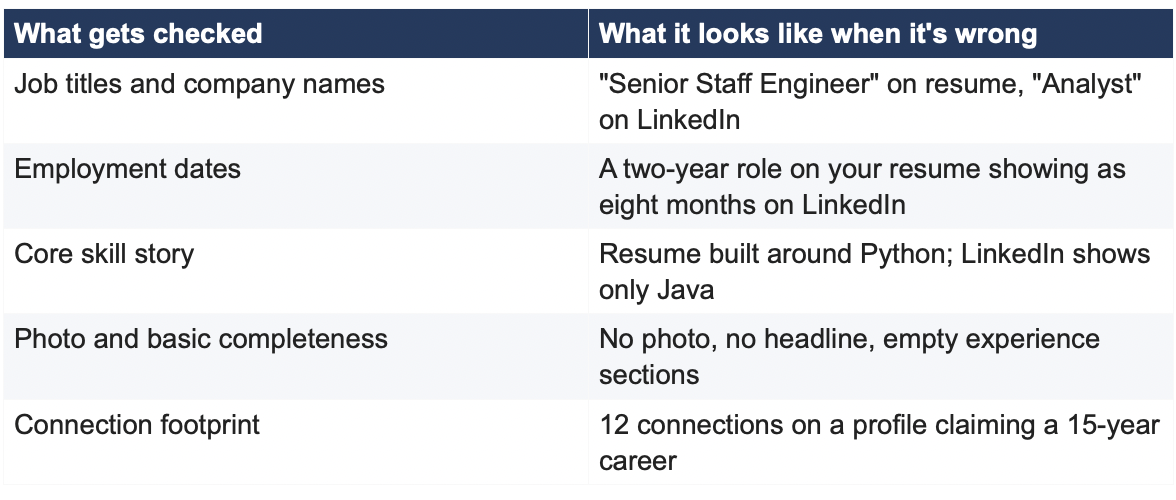
The connection footprint is the softest signal on the list, but worth understanding. A real 15-year career leaves a trail. Former colleagues, a recruiter or two, someone from a conference in 2019. That trail does not need to be impressive. It just needs to exist. A profile with 12 connections attached to a decade and a half of experience raises an eyebrow in a way that is hard to explain away.

How to Audit Your LinkedIn Before Your Next Application (In Under an Hour)
This is the same process I run with coaching clients before they start an active search:
Open your resume and your LinkedIn side by side.
Check every employer name and job title. Minor variations are fine. Structural differences are not.
Check your dates. They do not need to match to the month, but a two-year role on your resume showing as eight months on LinkedIn will get noticed.
Check your core skill story. If your resume is positioning you for a specific type of role, that skill set needs to be visible in how you describe your LinkedIn experience.
Add a photo if you do not have one. It does not need to be professional. It needs to look like a person, not a placeholder.
Make sure each role has at least a few lines describing what you actually did. Empty positions are a flag.
Do not worry about posts, engagement, or follower count. That is a different game and has nothing to do with getting past the verification check.
That is the whole thing. An hour of work removes one of the cheapest and most common reasons candidates get passed over without ever getting a call.
What This Means If You Are Making a Career Transition
If you are actively pivoting, the LinkedIn problem gets more layered, and it is one of the places I spend the most time with clients.
When you are changing directions, your profile is going to tell the story of where you have been, not where you are trying to go. That tension is real. It does not resolve by ignoring your profile, and it does not resolve by hiding your history.
It resolves through positioning: reframing what you have done in language that makes the connection between your past and your intended direction legible to someone who does not know you. A recruiter looking at your profile should be able to think: this person has been doing adjacent work and is making a deliberate move. Not: this resume and this profile belong to two different people.
That gap between where you have been and where you are going is not a liability. It is a narrative problem. Narrative problems have solutions. One of the things I do with clients in transition is work through exactly that: identifying the thread that connects what they have done to what they want to do, and making sure their materials reflect it consistently.
A profile that tells a coherent transition story, even an imperfect one, is almost always stronger than a profile that pretends the past did not happen.

Key Takeaways
Most companies now treat LinkedIn as a required verification layer. Many will not interview you without a complete profile.
A tailored resume that contradicts your LinkedIn skill story reads as fabrication, even when your experience is completely real.
Fake candidates with fully invented work histories are common enough that hiring teams have added verification steps as standard practice. Legitimate candidates pay the cost of that.
What actually gets checked: titles, companies, dates, core skill alignment, photo, basic completeness, and a believable connection footprint. Posts and engagement are irrelevant.
The audit takes under an hour. Do it before your next application cycle, not after you wonder why you are not hearing back.
Ready to Transform Your Life? Start With a Free Consultation
The most successful people don't wait for perfect conditions—they take action when they recognize an opportunity. If you've read this far, you're already considering whether coaching might be the catalyst you need to reach your next level of success and fulfillment.
Take the first step today by scheduling a free 60-minute consultation call with coach Jeff.
This is a no obligation call to see if coaching is right for you! Your future self will thank you for taking this crucial step today.

Frequently Asked Questions
Do recruiters actually check LinkedIn before interviews?
Yes—many recruiters and hiring managers do check LinkedIn before scheduling interviews, especially for professional, corporate, and remote roles. In my experience, LinkedIn has become less of a networking platform and more of a verification tool. Recruiters often compare your profile against your resume to confirm your job titles, employment dates, experience, and overall career story. They aren't looking for perfection—they're looking for consistency and credibility.
Should my LinkedIn profile match my resume?
Yes. Your LinkedIn profile and resume should tell the same core story about your career. They don't need to be identical, but your employers, job titles, dates, and primary skills should align. If your resume positions you for one type of role while your LinkedIn tells a completely different story, recruiters may question your credibility before you ever get a chance to explain.
Do I need to post on LinkedIn to get hired?
No. Posting on LinkedIn and having a strong LinkedIn profile are two completely different things. Most recruiters care far more about whether your profile accurately represents your experience than whether you've published articles or built a large following. A complete, professional profile with consistent information is far more valuable than posting every week.
How often should I update my LinkedIn profile?
Update your LinkedIn whenever your resume changes in a meaningful way. If you've accepted a new role, completed a major project, earned a certification, developed new skills, or are repositioning yourself for a different type of job, your profile should reflect those changes. An outdated LinkedIn profile paired with a recently updated resume is one of the easiest ways to create unnecessary doubt during the hiring process.
How do I optimize my LinkedIn profile for a career change?
The goal isn't to hide your previous experience—it's to connect it to where you're going next. Rewrite your headline, About section, and job descriptions to emphasize transferable skills and explain the progression in your career. Recruiters should be able to understand why your transition makes sense after spending just a few minutes on your profile.
Can recruiters reject you because your LinkedIn doesn't match your resume?
They usually won't tell you that's why—but yes, it can happen. When your LinkedIn profile and resume tell different stories, recruiters may wonder which version is accurate. In competitive hiring processes, uncertainty is often enough for someone to move on to another candidate. Keeping your resume and LinkedIn aligned removes one of the most common—and most invisible—reasons qualified candidates get screened out.
Does not having a LinkedIn profile hurt your job search?
Sometimes. Not every employer checks LinkedIn, but many recruiters use it as a quick way to verify a candidate's professional history before reaching out. If you're applying to professional, corporate, or remote positions, having a complete LinkedIn profile generally improves your credibility and makes it easier for recruiters to confirm your experience.
Why am I not getting recruiters on LinkedIn?
There are many possible reasons, including the types of roles you're targeting and the current job market. However, one of the most overlooked reasons is poor positioning. If your profile doesn't clearly communicate your skills, achievements, and the type of role you're pursuing—or if it contradicts your resume—recruiters may simply move on without reaching out.
How can I improve my LinkedIn profile in less than an hour?
Start with the basics. Make sure your job titles, employment dates, employers, and primary skills match your resume. Add a professional photo if you don't already have one, complete the description for each role, and update your headline to reflect the type of opportunities you're pursuing. You don't need to rewrite your entire profile—a simple one-hour audit can eliminate many of the inconsistencies that cause recruiters to hesitate.

I’m Jeff Rothenberg, a personal growth and career coach helping people turn uncertainty into confidence and clarity. Whether you’re rebuilding after change, exploring your next career move, or simply ready to grow, I’ll help you create momentum that lasts.
