
The Y Theory: Why Smart People Keep Making the Same Dumb Career Choices

Alissa (name changed for confidentiality) is in her mid 30’s, lives with her parents in Phoenix, and makes just above minimum wage as a veterinary technician.
She's genuinely good at her job. She loves animals. Her coworkers respect her skills. On paper, she's doing fine.
Except she can't afford her own apartment. She's given up on dating because bringing someone home to her childhood bedroom feels humiliating. She spends her evenings watching Netflix in the same house she grew up in, feeling like her life is on pause while everyone else moves forward.
When she came to me for career transition coaching, she was stuck in what I call the "comfort prison." She knew something had to change, but every time she thought about making a move, she'd talk herself out of it. The familiar trap felt safer than the uncertain path forward.
This pattern shows up constantly with the mid-career professionals I work with as a career transition coach and confidence coach here in Phoenix and Scottsdale. People who are objectively capable, who know intellectually what needs to change, but who keep making the same choices that keep them stuck.
There's a psychological framework that explains exactly what's happening. It's called the Y Theory, developed by psychologist Guillaume Dulude, and once you understand it, you'll see these decision points everywhere in your career and life.
Every Day, You're Standing at a Fork in the Road
Think about the last time you faced a real decision:
Should you speak up in that leadership meeting or stay quiet? Do you set a boundary with your demanding boss or just work another weekend? When you feel undervalued, do you advocate for yourself or swallow the disappointment? Do you stay in the familiar role that's slowly killing your soul or take the risk on something that actually excites you?
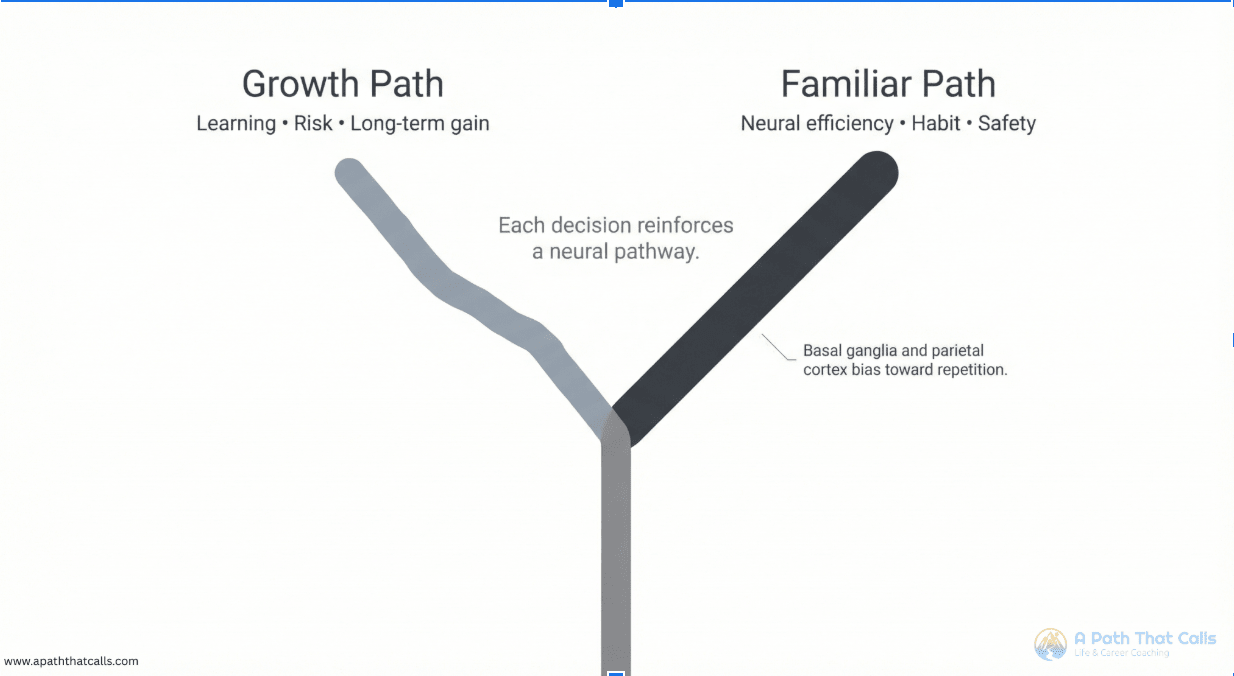
Each of these moments creates what Dulude calls a Y-shaped decision point. Two paths diverge. One is deeply familiar. The other is uncertain and uncomfortable.
Here's what most people don't realize: you make these choices dozens of times per week. And most of them happen so fast, so automatically, that you don't even know you're choosing.
The Right Branch: The Comfort Prison
The right branch represents the path your nervous system already knows. It's the automatic reaction, the familiar pattern, the decision you've made countless times before.
Your brain absolutely loves this path. As Dulude explains: "Your brain prefers what is familiar over what is good."
Your brain doesn't optimize for your happiness or success. It optimizes for survival and efficiency. And from your brain's perspective, familiar equals safe, even when familiar is slowly destroying your life.
For Alissa, the right branch was staying in veterinary work. She knew how to do the job. She could show up on autopilot. There were no scary unknowns. Her parents' house was rent-free. The whole situation was predictable.
It was also a dead end that kept her dependent, lonely, and stuck.
Neuroscience research reveals why these patterns are so powerful. Studies show that humans exhibit massive repetition bias independent of actual outcomes. Your parietal cortex tracks previous choices and actively biases you toward repeating them. With enough repetition, your basal ganglia literally takes over, shifting control away from your conscious mind to automatic circuits.
This is why you keep ending up in similar situations. Taking jobs with bosses who recreate unhealthy dynamics. Avoiding difficult conversations even though silence costs you opportunities. Staying in roles long past their expiration date because starting over triggers overwhelming anxiety.
The right branch feels safe because it's familiar. But familiar and safe are not the same thing. Sometimes familiar is just a slower form of drowning.
Why This Isn't a Character Flaw
When Alissa first told me about her situation, she was ashamed. She kept saying "I should have figured this out years ago."
But repeated patterns aren't character flaws. They're survival strategies that worked brilliantly at some point in your life.
Maybe staying quiet kept you safe when speaking up meant getting shut down. Perhaps overworking earned you approval when nothing else did. Maybe playing small meant you avoided the crushing fear of visible failure.
These strategies became hardwired into your neural architecture. They're not conscious choices anymore. They're reflexes. Programs running automatically in the background of your life.
Your brain installed these programs years ago and never bothered to check whether they still serve you. It just keeps running them because that's what brains do with familiar patterns.

The Left Branch: Where Your Real Life Is Waiting
The left branch represents who you're becoming, not who you've always been.
When Alissa and I worked through her STRONG Interest Inventory assessment, something became clear. Her scores showed strong interest in healthcare and working directly with people, not just animals. She had mechanical aptitude. She valued helping others in tangible ways.
The assessment pointed toward a path she'd never considered: radiology technology.
Less than two years of school. Working in healthcare. Direct patient interaction. And a starting salary around $80,000 with long-term potential near $100,000. Enough money to move out, build independence, start dating without embarrassment, have an actual adult life.
This was her left branch. And everything in her system resisted it.
Going back to school meant admitting her current path wasn't working. It meant being a beginner again. It meant student loans and uncertainty and the possibility of failure. It meant her coworkers might judge her for leaving.
The left branch requires tolerating serious discomfort. It demands that you choose growth over familiarity, possibility over predictability, your real future over your comfortable prison.
Your nervous system sees this path as dangerous. So even when you intellectually know the left branch is the better choice, everything in your body pulls you toward the right. Every single time.

The Moment Where Everything Hangs
The power of understanding the Y Theory isn't just recognizing these two paths exist. It's learning to catch yourself at the exact moment you're standing at the crossroads.
That moment is where your freedom lives.
Alissa's Y moment came during one of our intensive sessions. We were looking at her assessment results, discussing the radiology path, and I watched her face shift. She got quiet. Her shoulders tensed. She started generating reasons why it wouldn't work.
"I'm too old to go back to school." "What if I fail?" "My parents will think I'm being impulsive." "Maybe I should just find a higher-paying vet tech position."
I stopped her. "You're at a Y right now. Can you feel it?"
She nodded slowly. "It feels like I'm about to do something scary and stupid."
"Or scary and exactly right," I said. "Your brain can't tell the difference. It just knows this path is unfamiliar."
That recognition changed everything. Not because awareness magically made the fear disappear. But because she could finally see that her resistance wasn't wisdom. It was just her nervous system doing what nervous systems do: protecting her from the unfamiliar.

How to Actually Choose the Left Branch
Recognition is essential, but it's not enough. You need specific strategies to override decades of neural programming.
After that session, Alissa started texting me every time she felt herself at a Y moment. "My dad just asked if this school thing is really a good idea," one text read. "I can feel myself wanting to say maybe he's right."
We'd talked about this. How naming the Y out loud interrupts the automatic pattern. Your brain literally shifts from autopilot to conscious choice. That text accountability broke her loop before she could spiral into familiar doubt.
I had her write something on her bathroom mirror: "Scared means growing." Research from Cornell shows that when people reframe discomfort as a signal of progress rather than a warning sign, they're significantly more likely to choose growth paths. The left branch feels uncomfortable because it's unfamiliar, not because it's wrong.
We also did an exercise where she described in detail what her life would look like at 35, 40, 45 if nothing changed. Still at her parents' house. Still making just above minimum wage. Still watching other people build the lives she wanted. That clarity made the left branch's risks feel manageable by comparison.
This is the foundation of effective confidence coaching: not pumping people up with false positivity, but building their capacity to recognize choice points and tolerate the discomfort of choosing differently.
Alissa's first left-branch choice wasn't enrolling in radiology school. It was researching programs. Then scheduling an admissions appointment. Then taking one prerequisite class. Small, repeated left-branch choices create the neural pathways for bigger ones.

What Actually Happens When You Choose Differently
The first few times you choose the left branch, it feels terrible. Alissa called me two weeks into her first semester, convinced she'd made a huge mistake. The coursework was harder than she expected. She felt stupid compared to younger students. She wondered if she should just go back to the vet clinic and forget the whole thing.
"This is supposed to feel like this," I told her. "Your nervous system is screaming that you're in danger because you're doing something unfamiliar. But you're not actually in danger. You're just growing."
Something remarkable happens with repetition, though.
The left branch starts feeling less foreign. The discomfort becomes tolerable. Your brain begins recognizing that choosing growth doesn't actually kill you. New neural pathways strengthen. The old right-branch pathway starts to weaken from disuse.
Three months into her program, Alissa sent me a text: "I actually love this. I'm good at it. I can see my whole life changing."
Twelve months in, she'd moved into her own apartment. Small, nothing fancy, but hers. She'd gone on three dates. She was studying with a group of classmates who'd become genuine friends.
She didn't become a different person. She just learned to recognize her Y moments and built the capacity to choose differently.

Your Brain Can Change, But You Have to Drive It
Your brain remains plastic throughout your life. You're not doomed to repeat the same patterns forever. But neuroplasticity doesn't happen passively. You can't think your way into new neural pathways. You have to build them through repeated action, through choosing the left branch over and over even when everything pulls you toward the familiar right.
The career transition coaching work I do with clients isn't about cheerleading or positive thinking. It's about using professional assessments to identify where their genuine strengths and interests point, then building the capacity to choose the left branch even when it's terrifying. It's confidence coaching grounded in evidence and action, not affirmations.
I think about Alissa in that session, her shoulders tense, her face tight with fear, generating every reason why the radiology path wouldn't work. That was her standing at the Y. That was the moment her whole life hung in the balance.
She could have chosen the familiar prison. Most people do.
Instead, she took a breath, looked at me, and said: "Okay. Tell me what the first step actually is."
That's the moment everything changed. Not when she graduated. Not when she moved out. Not when her life finally looked different from the outside.
The moment she chose the left branch, even though every cell in her body was screaming to turn back.
That moment is available to you too. The question is whether you'll recognize it when it comes.
Ready to Transform Your Life? Start With a Free Consultation
If you're standing at your own Y moment right now and keep choosing the familiar path even though you know it's keeping you stuck, let's talk.
Take the first step today by scheduling a free 60-minute consultation call with coach Jeff and we'll figure out what your left branch actually looks like.
This is a no obligation call to see if coaching is right for you! Your future self will thank you for taking this crucial step today.
Frequently Asked Questions:
What is the Y Theory?
The Y Theory is a psychological framework developed by Guillaume Dulude that explains how every significant decision creates a fork in the road. One path is familiar and automatic (the right branch), while the other is uncomfortable but growth-oriented (the left branch). Your brain strongly prefers the familiar path even when it's harmful, which is why breaking patterns requires conscious effort and specific strategies.
Why do smart people stay stuck in jobs they've outgrown?
Because your brain prefers what is familiar over what is good. Neuroscience shows that repetition creates powerful neural pathways that bias you toward repeating the same choices, even when those choices no longer serve you. This isn't a character flaw or lack of intelligence. It's how human brains are wired for survival and efficiency.
How do I recognize when I'm at a Y moment?
Y moments often show up as physical tension (tight chest, clenched jaw, knot in your stomach) or as rapid-fire rationalization. If you suddenly find yourself generating multiple reasons why change won't work or why you should stick with the familiar option, you're probably at a Y. Other signs include phrases like "I should just..." or "Maybe it's not worth the conflict."
How can I stop repeating the same career mistakes?
You need to build your capacity to tolerate the discomfort of unfamiliar choices. This happens through small, repeated left-branch decisions that create new neural pathways. Working with a career transition coach or confidence coach can accelerate this process by helping you identify your Y moments in real time and providing accountability when your nervous system pulls you back toward familiar patterns.
Do I need a coach to make a successful career change?
You can absolutely make career changes on your own, but working with a career transition coach provides several advantages: professional assessments that reveal where your strengths actually point, an outside perspective on your blind spots and patterns, accountability when you're at Y moments, and evidence-based strategies for building new decision-making capacity. Most importantly, a good coach helps you distinguish between nervous system resistance (which you should push through) and genuine intuition (which you should listen to).

I’m Jeff Rothenberg, a personal growth and career coach helping people turn uncertainty into confidence and clarity. Whether you’re rebuilding after change, exploring your next career move, or simply ready to grow, I’ll help you create momentum that lasts.
