

If you are researching executive coaching, one of the first questions you are likely to ask is practical: How much does executive coaching cost?
The short answer is that it varies widely. A single session may cost a few hundred dollars, while a structured executive-coaching engagement can run into the low five figures or more. The difference usually reflects the coach’s experience, the seniority and complexity of the leader’s role, the duration of the engagement, the degree of organizational involvement, and whether the work includes assessments, sponsor alignment, stakeholder feedback, or support between sessions.
Executive coaching is not a standardized service. Some coaches work one session at a time. Others build three-, six-, or twelve-month engagements around specific leadership goals. Some engagements include written development plans, assessments, sponsor conversations, progress reviews, and access between meetings. Others are essentially a recurring one-hour conversation.
Those are very different experiences, which is why I do not think the most useful way to evaluate executive coaching is to divide the total fee by the number of sessions.
The Investment Costs
In my practice, Executive Coaching is $10,000 for six months. We meet twice per month for 60 minutes, for a total of 12 sessions. The engagement includes a tailored assessment process, written development goals, sponsor alignment when an organization is sponsoring the work, progress reviews, and reasonable text and email access between sessions.
For senior leaders who would benefit from a broader understanding of how they are experienced across the organization, I offer an interview-based stakeholder feedback process for an additional $3,000. That work includes conversations with the leader’s manager or sponsor, peers, and direct reports, followed by synthesis, reporting, and a structured feedback debrief.
I also offer Leadership Coaching for $6,000 over six months for emerging leaders, managers, directors, VPs taking on greater responsibility, and entrepreneurs who want serious leadership development but may not need the broader organizational components of an executive engagement.
The better question, then, is not simply, What does an executive coach charge? It is: What kind of change are you trying to create, and what level of support will make that change more likely?
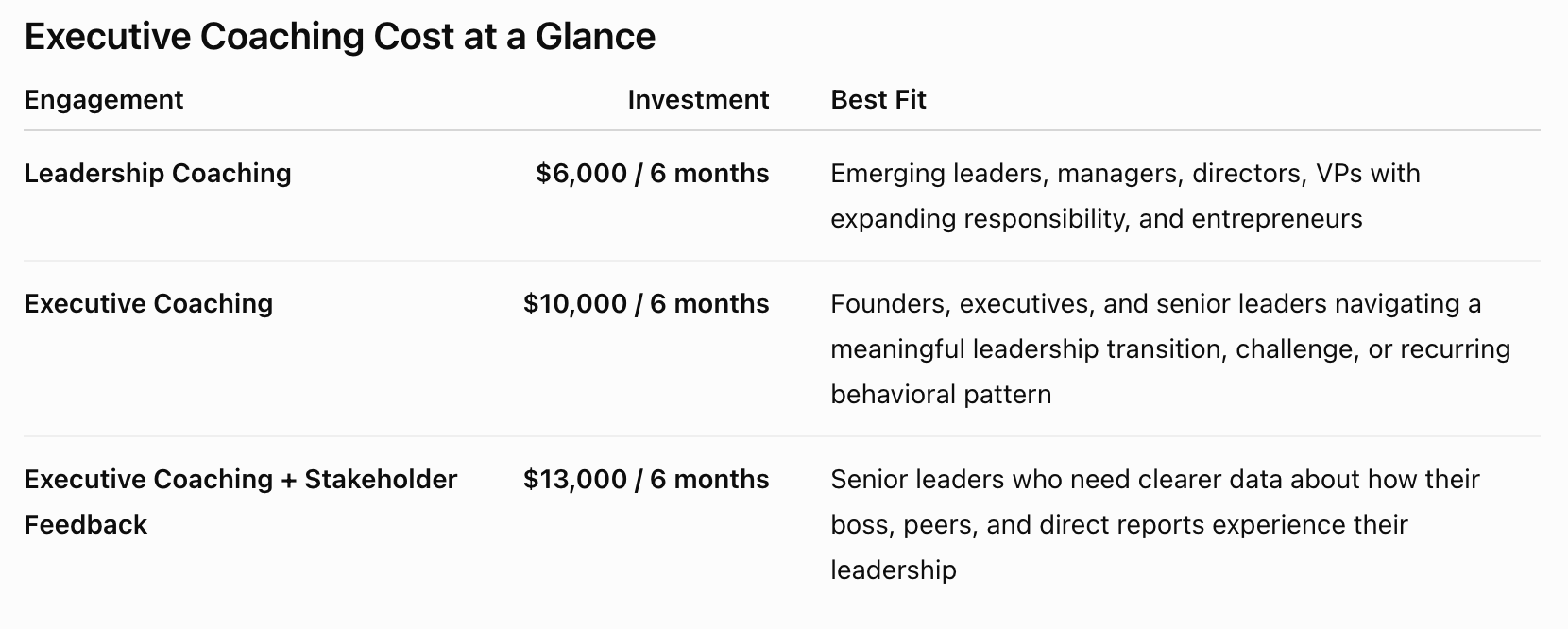
The difference between these options is primarily scope, not the amount of care I bring to the person. Leadership Coaching still includes 12 60-minute sessions, written development goals, progress reviews, and reasonable between-session support. It is intentionally designed without the formal sponsor alignment and interview-based stakeholder feedback that may be useful in more complex executive engagements.

What Determines Executive Coaching Cost?
Executive coaching fees usually reflect the complexity of the engagement rather than simply the number of scheduled sessions.
The coach’s experience matters. So does the level of responsibility the client carries. Coaching a first-time manager through delegation and difficult conversations is not the same scope as working with a founder whose behavior affects a company of several hundred people, or a senior executive whose success depends on influencing peers, board members, direct reports, and a CEO.
Duration matters too. A single conversation can be useful, but sustained behavioral change usually requires time to identify patterns, experiment with different behaviors, gather feedback, and adjust.
The price may also reflect assessments, development planning, sponsor involvement, stakeholder interviews, progress reviews, and support between sessions. A company-sponsored engagement often has more complexity than an individual leader simply hiring a coach privately.
That is why two coaches can both offer “executive coaching” while selling fundamentally different services.
That is also why I would look beyond price alone when comparing coaches. My Executive Coaching page explains how I structure the work around assessments, clear development goals, sponsor alignment, ongoing coaching, and measurable progress over time.
If you want a broader overview of what the work actually looks like before getting into pricing, I explain the process in more detail in What Is Executive Coaching? How It Works, Who It’s For, and Why It Matters.
You Are Not Paying $10,000 for Twelve Hours of Conversation
You are paying for a six-month leadership-development process.
Most meaningful leadership challenges are not isolated problems that disappear once someone gives you good advice. They are patterns that have often developed over years.
A founder may know they need to delegate but still take back control every time something important starts going wrong. An executive may repeatedly hear that they are too direct, too controlling, too vague, or too conflict-avoidant, yet struggle to behave differently when the pressure rises. A leader may have been exceptional with a team of twenty and discover that the same operating style begins to fail when the organization reaches one hundred.
Those challenges require more than insight. The leader has to understand what is happening, try something different, return to the real world, see how people respond, reflect on the result, and make another adjustment.
That process takes time, which is why I believe six months is long enough for meaningful work without creating an indefinite coaching relationship.

Why Six Months?
Early in an engagement, I am learning the person. I am learning how they think, what they value, what motivates them, what they avoid, what happens when they are under pressure, where they are strongest, and where the same patterns keep appearing.
The client is also learning whether they can trust me.
That matters because senior leaders are often very good at giving the polished version of what is happening. They spend years communicating upward, reassuring teams, managing perceptions, and projecting confidence when the circumstances around them may be anything but certain.
The deeper work often begins when someone is comfortable enough to say, “Here is what I am actually worried about,” or, “I know I am contributing to this problem, but I cannot seem to stop doing it.”
Personal development also requires repetition. You may leave a session with a clear insight about delegation, communication, or a difficult relationship. The real learning starts when you try something different and discover what happens when you are tired, frustrated, rushed, or defensive.
Breakthroughs happen in coaching, but they are rarely the result of one brilliant question. More often, they happen because someone has spent months becoming more aware of themselves, experimenting, receiving feedback, and finally seeing a pattern clearly enough to change it.

What Is Included in My $10,000 Executive Coaching Engagement?
I do not want executive coaching to become twelve disconnected conversations where we simply ask, “What should we talk about today?” There should be enough structure to create momentum while still leaving room for the very real issues that arise during the engagement.
We begin with a tailored assessment process. Depending on the leader’s goals, that may include tools such as MBTI, CliftonStrengths, Strong Interest Inventory, or VIA Character Strengths. I select tools based on what we are trying to understand rather than giving every client the same battery of assessments. The purpose is not to hand someone a report and tell them who they are. Assessments give us another source of evidence about how a leader naturally operates, where they gain energy, what motivates them, which strengths they may be overusing, and where blind spots may exist.
We then establish written development goals so we know what we are actually trying to change. A coaching engagement should be flexible enough to address the issues happening right now, but it should not lose sight of the larger reason the engagement exists.
For organization-sponsored coaching, sponsor alignment is included. That means understanding what the organization hopes will develop, how success is being defined, and what the leader’s boss or sponsor is seeing from their perspective.
Sponsor alignment does not mean I report the contents of coaching conversations back to the boss. The coaching relationship remains confidential. Progress conversations focus on agreed-upon development goals, broad themes, and observable change rather than private conversations from coaching sessions. That distinction is critical if the leader is going to be candid enough for the work to matter.
We also conduct progress reviews during the engagement instead of waiting until the end to ask whether anything changed.
Finally, clients have reasonable text and email access between sessions for time-sensitive leadership situations. That might mean thinking through a difficult conversation, reflecting after an important meeting, or asking for perspective before responding to a challenging situation. It is not unlimited on-demand consulting or a replacement for scheduled coaching sessions.
Leadership problems do not conveniently arrive every other Thursday at 2 p.m. Having some continuity between sessions helps the coaching stay connected to the actual work.

What Experience Adds to Executive Coaching
Of course you are paying for my time, but you are also paying for judgment.
You are paying for a thinking partner who can recognize patterns, challenge assumptions, and help you distinguish between a leadership issue, a people issue, and a systems issue.
My perspective comes from more than fifteen years spent inside high-growth organizations building teams, recruiting and developing talent, hiring leaders, managing performance, navigating rapid growth, and making difficult people decisions.
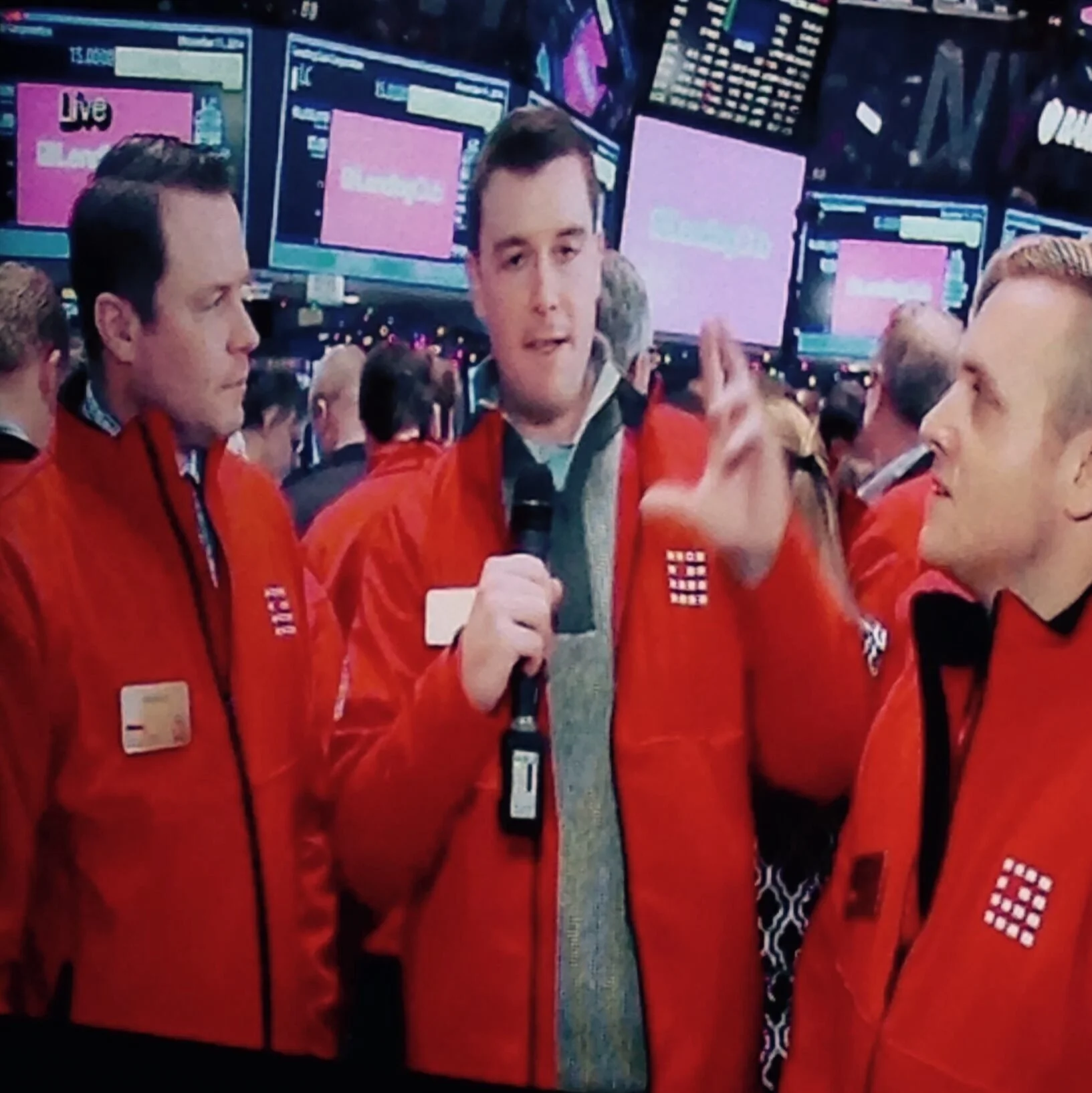
I have helped scale teams from almost nothing to more than one hundred employees. I was part of LendingClub during a period of significant growth and later joined Upgrade as one of the earliest employees in Phoenix, helping build an operations organization that grew to hundreds of people.
Some of the lessons that shaped me most, however, did not come from the things that went well. They came from the things that broke.
I have hired people I was confident would succeed and watched the hire fail. I have seen systems work beautifully at one stage of growth and collapse at the next. I have managed underperformance, made difficult personnel decisions, navigated layoffs, and seen what happens when a team grows faster than the leadership systems around it.
That operating experience matters because the problem a leader brings into coaching is not always the real problem.
An executive may think they have a communication problem when they actually have the wrong people in key roles. A founder may believe the team needs more accountability while unknowingly undermining accountability by stepping back into every difficult decision. A leader may think an employee needs more motivation when expectations have never been made clear.
Having spent much of my career as a recruiter, hiring manager, people leader, and operator gives me different lenses through which to examine those situations.
That experience does not mean I arrive with a prepackaged answer for your company. It means I can often help you get to the real question faster.
My Job Is Still to Coach You
Operating experience does not mean coaching becomes me telling you how to run your company.
Your business is different from the ones I helped build. Your personality is different. Your team is different. Your life is different.
My role as a coach is to expand your field of view.
Senior leaders spend much of their lives solving problems for everyone else. They often have very few places where they can step outside the urgency of the business and look carefully at themselves.
What am I not seeing? Why do I keep reacting this way? What am I avoiding? What kind of leader am I becoming? What do I actually want? What needs to change in me before I expect everyone around me to change?
You usually have more wisdom inside you than you realize. The challenge is that when you live inside a problem every day, it can be very difficult to see the whole picture.
A good coach creates enough space, structure, challenge, and perspective for you to see more clearly and make your own better decisions.

Executive Coaching Is Also Identity Work
Some leadership coaching stays close to tactics: delegation, difficult conversations, communication, accountability, meeting effectiveness, executive presence, and decision-making.
Those things matter, but I think the work becomes much more powerful when we go underneath them.
Who are you beyond the titles you hold? What is the vision you have for your life? What are your core values? What kind of leader do you want people to experience? What do you want your career to make possible outside of work?
Then comes the harder question: does your actual behavior reflect those answers?
If you say family is one of your most important values but you have not been home for dinner in two weeks, that is worth looking at. If you say developing people matters deeply to you but you solve every important problem yourself, there is a gap. If you say honesty is central to your leadership but you have avoided the same performance conversation for six months, your behavior is telling a different story.
Those are identity questions, but they become practical very quickly.
The goal is to reduce the distance between the leader you say you want to be and the leader other people actually experience every day.
A Confidential Place Where You Do Not Have to Perform
Senior leadership can be lonely.
The more responsibility you have, the fewer places you can speak completely freely. Your employees need something from you. Your peers have their own perspectives and interests. Your boss evaluates you. Even the people closest to you personally may not fully understand the pressures of your role.
Coaching gives you a confidential place where you do not have to perform.
You can say what you are actually thinking. You can admit that you are unsure. You can talk about the difficult leadership decision you keep postponing or acknowledge that the company and career you worked so hard to build may be creating a life you are not sure you want anymore.
The point is not to wallow in the difficulty. The point is to have a place where you can be candid enough to work through it thoughtfully before your decisions ripple through an entire organization.

What Is Interview-Based Stakeholder Feedback?
Sometimes the most important development question is not simply, What does this leader want to improve? It is, How is this leader actually experienced by the people around them?
That is when I may recommend adding the $3,000 interview-based stakeholder feedback process.
The process can include conversations with the leader’s manager or sponsor, peers across the organization, and direct reports. I look for recurring themes across those conversations, synthesize the information, and use it to identify the few patterns that appear most important.
This typically adds another six to ten hours of interviewing, analysis, synthesis, and reporting, which is why it is priced separately from the core executive engagement. The goal is not a popularity score. It is not about compiling anonymous complaints. We are trying to understand impact.
A leader may believe they are empowering while their team experiences them as controlling. They may believe they communicate clearly while several peers leave meetings unsure about what was decided. They may also discover strengths and positive behaviors that other people value much more than they realized.
The feedback gives us better data about where intention and impact align, where they differ, and what behavior changes are most likely to matter.
Does Every Executive Need Stakeholder Feedback?
No. If the development goals are already clear, the sponsor has good visibility into the leader, and we already have enough evidence to know where the work should focus, adding stakeholder interviews may create more complexity without adding enough value.
I am much more likely to recommend the process when a leader’s effectiveness depends heavily on cross-functional influence, when a founder is moving into a very different stage of leadership, when someone is preparing for a significant promotion, or when there appears to be a meaningful gap between how the leader sees themselves and how others experience them.
Sometimes the most important thing a leader can learn is that their impact is different from their intention.

Leadership Coaching Cost: $6,000 for Six Months
Not every leader needs the $10,000 executive structure.
I also work with emerging leaders, managers, directors, VPs taking on increasing responsibility, and entrepreneurs who are growing into a larger version of leadership.
Someone may have been an exceptional individual contributor and suddenly find themselves responsible for a team. A director may be managing managers for the first time. A VP may be shifting from deep functional expertise into broader organizational leadership. An entrepreneur may discover that being excellent at creating a product or winning customers does not automatically prepare them to lead a growing company.
For those situations, Leadership Coaching is $6,000 for six months and includes 12 60-minute sessions, written development goals, progress reviews, and reasonable between-session support.
The work can still go deep. We may focus on self-awareness, delegation, accountability, communication, decision-making, difficult conversations, leadership identity, values, and how to build a team and culture people want to be part of.
The distinction is scope. These leaders may benefit enormously from structured development and accountability without needing formal sponsor alignment or a broader interview-based stakeholder process.

Executive Coaching Versus Fractional Leadership Consulting
I also provide fractional leadership consulting, and I think it is important to understand the difference.
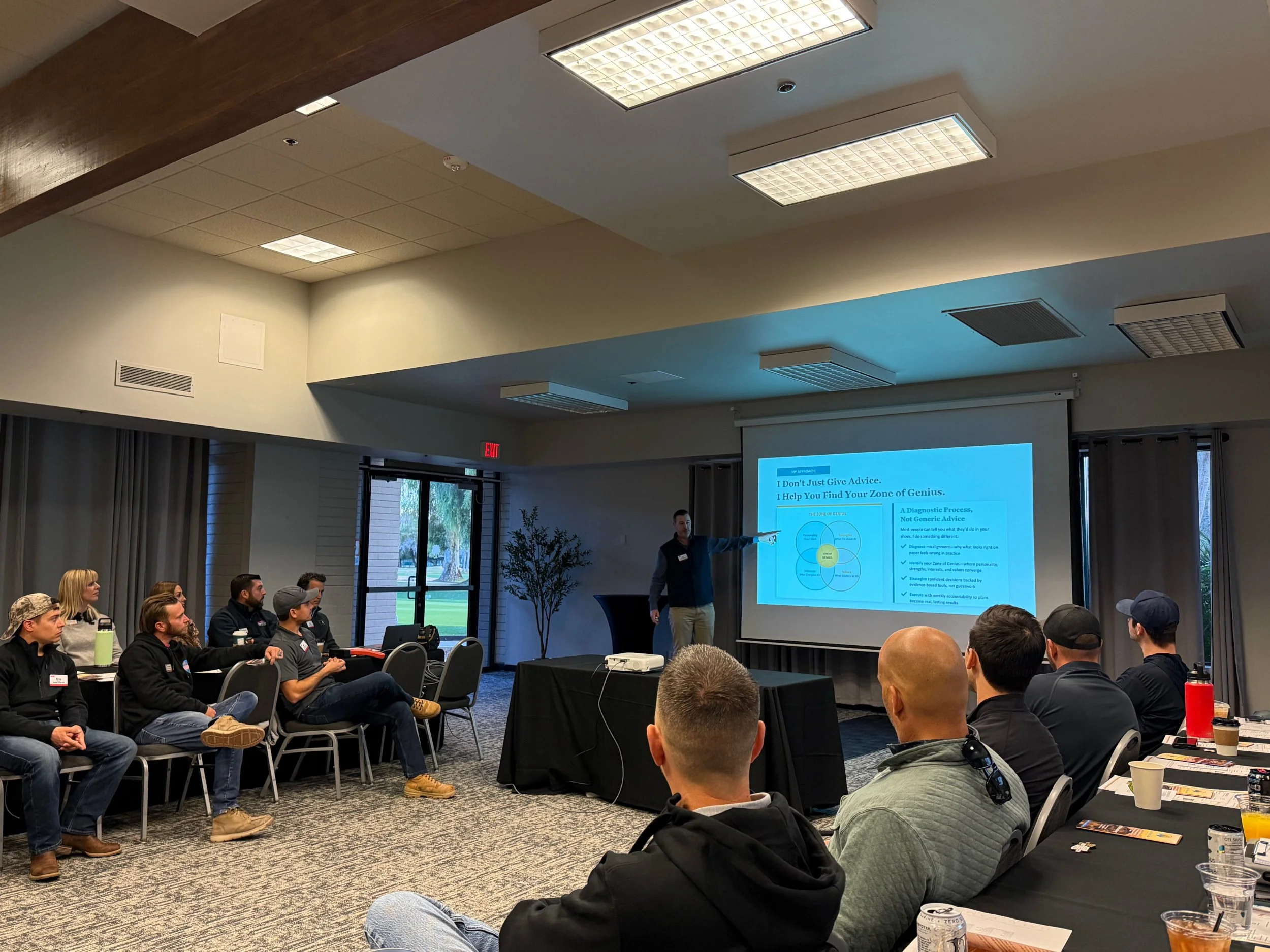
In coaching, you are ultimately doing the thinking and making the decisions. I ask questions, challenge assumptions, help identify patterns, bring structure, and sometimes share perspective from my operating experience. The purpose is to help you become a stronger thinker and leader.
Consulting is more directive.
In a fractional consulting engagement, I may spend meaningful time inside the organization, work directly with department leaders, observe how work is happening, evaluate hiring processes, look at team structure, identify operational problems, and recommend concrete changes.
In consulting, I am much more likely to say, “Here is what I think you should do.” Sometimes the company needs coaching. Sometimes it needs consulting. Sometimes there is a place for both.
A good initial conversation should help determine which problem you actually have rather than forcing every challenge into a coaching engagement.
If what the organization really needs is someone to get closer to the work, evaluate what is happening, and recommend operational changes, that moves beyond coaching. My Fractional Advisory and Leadership Consulting work is more hands-on and directive, with a greater focus on areas such as leadership systems, hiring, team structure, operations, and organizational effectiveness.
When Is Executive Coaching Worth the Investment?
I do not think executive coaching is automatically worth $10,000 because someone has an impressive title. There has to be something meaningful enough to work on.
A founder may have become the bottleneck in a company that has outgrown the way they have always led. A newly promoted executive may need to stop personally managing work and learn how to lead other leaders. A talented leader may keep receiving the same feedback but have been unable to change the pattern.
Another executive may need to become significantly better at delegation, accountability, communication, influence, difficult conversations, or creating a high-performing culture.
The return on those changes is difficult to reduce to a simplistic formula, and I would be skeptical of anyone promising that coaching automatically produces a specific financial ROI.
What we do know is that the stakes increase as leadership responsibility increases. A senior leader affects who gets hired, who leaves, how decisions are made, what behaviors become normal, how people experience the culture, and how effectively entire teams perform.
The farther a leader’s influence travels, the more their behavior matters. That is when coaching can become a meaningful investment.
When Executive Coaching Is Probably Not Worth It
There are situations where I would discourage someone from spending the money.
If the leader has no ownership of the problem and no genuine desire to change, coaching is unlikely to produce much. If an organization has already decided that someone needs to leave and is using coaching to postpone the personnel decision, I do not think that is a healthy use of coaching.
Coaching is also not the answer to every organizational problem. Chronic understaffing, an unclear strategy, broken incentives, or a dysfunctional operating model may require structural changes rather than individual development.
And if the organization really wants someone to come in, diagnose the business, and tell the leadership team what should change, that is consulting.
Coaching works best when the leader genuinely wants to understand themselves more deeply, is willing to hear feedback they may not love, and has enough authority and room to experiment with different behaviors. The coach cannot want the change more than the client.

How Should You Compare Executive Coaches?
I would not begin with hourly rates. Start with the person and the process.
Understand what experience informs the coach’s judgment and whether they understand the kinds of situations you are dealing with. Ask how development goals are established, how assessments are used, how progress is evaluated, and what role the organization or sponsor plays.
Understand what confidentiality means. Ask what support is available between sessions. Ask how the coach thinks about coaching versus consulting and what happens if the work reveals that your original problem is not actually a coaching problem.
Then pay attention to something that is harder to quantify: Do you trust this person enough to tell them the truth?
If every coaching session becomes another place where you feel like you need to perform, manage perceptions, or present the polished version of yourself, the relationship is unlikely to produce the depth of work you are paying for.
What Are You Really Buying?
The important comparison is not simply price per session. It is the level of structure, perspective, accountability, trust, and support required for the change you are trying to create.
Ultimately, you are buying a place to become a better leader. You are buying someone who will ask questions that are difficult to ask yourself, challenge assumptions you may not realize you are making, create accountability around changes you already know you need to make, and provide enough distance from your world to see things that are difficult to see from inside it.
You are buying a confidential place where you can say the thing you cannot always say in the leadership meeting.
And depending on the coach, you may also be buying judgment earned from years spent dealing with the same messy realities you are dealing with now: hiring, firing, growth, culture, performance, conflict, ambition, failure, leadership, and identity.
The question is not whether every executive coach is worth $10,000.
The better question is whether the right coaching relationship, focused on the right problem, with a leader who genuinely wants to grow, can create enough meaningful change to justify the investment.
For the right leader at the right moment, I believe it can.
Ready to Explore Executive Coaching?
You do not need to arrive with a perfectly defined coaching goal. A first conversation can help clarify what is happening, where you feel stuck, what your organization is asking of you, and whether coaching is actually the right solution.
From there, we can determine whether Leadership Coaching, Executive Coaching, interview-based stakeholder feedback, fractional leadership consulting, or another approach best fits the situation.
If you are considering support for yourself or a leader in your organization, the next step is simply a confidential conversation to understand the problem before deciding what kind of investment makes sense.
Take the first step today by scheduling a free 60-minute consultation call with coach Jeff.
This is a no obligation call to see if coaching is right for you! Your future self will thank you for taking this crucial step today. Best, Jeff Rothenberg

Frequently Asked Questions About Executive Coaching
How much does executive coaching cost?
Executive coaching costs vary significantly depending on the coach, the seniority of the client, the length and structure of the engagement, and whether the work includes assessments, sponsor alignment, stakeholder interviews, or between-session support. Individual sessions may cost a few hundred dollars, while structured multi-month executive engagements can reach the low five figures or more.
What is included in executive coaching?
The scope varies by provider. My six-month Executive Coaching engagement includes 12 60-minute coaching sessions, a tailored assessment process, written development goals, sponsor alignment for organization-sponsored engagements, progress reviews, and reasonable text and email support between sessions.
How much does your executive coaching cost?
My Executive Coaching engagement is $10,000 for six months. Interview-based stakeholder feedback can be added for $3,000, bringing the total engagement to $13,000.
How much does leadership coaching cost?
My Leadership Coaching engagement is $6,000 for six months. It includes 12 60-minute coaching sessions, written development goals, progress reviews, and reasonable between-session support. It is designed for emerging leaders, managers, directors, VPs taking on greater responsibility, and entrepreneurs who may not need the broader organizational structure of executive coaching.
Is stakeholder or 360-degree feedback worth it?
It can be very useful when the primary development question involves how the leader is experienced by other people. An interview-based process can reveal recurring themes across the leader’s manager, peers, and direct reports and help identify gaps between intention and impact.
How long does executive coaching usually last?
Executive coaching can range from several sessions to engagements lasting a year or longer. I prefer six months because it provides enough time to build trust, identify patterns, establish meaningful goals, experiment with new behaviors, gather feedback, and make adjustments.
Does an employer usually pay for executive coaching?
Many executive-coaching engagements are employer-sponsored, particularly when coaching is being used to support leadership development, succession planning, promotion, or work with high-potential executives. In those situations, sponsor alignment can connect the development goals to organizational expectations while the contents of the coaching conversations remain confidential.
What is the difference between executive coaching and consulting?
Executive coaching helps the leader increase self-awareness, think more clearly, establish goals, and change their own behavior. Consulting is more directive. A consultant evaluates an organizational or operational problem and recommends what the company should change. Some situations benefit from both, but they are different forms of work.
Is executive coaching only for C-suite leaders?
No. Founders, entrepreneurs, VPs, directors, managers, and emerging leaders can all benefit from coaching. The right structure depends less on the title than on the complexity of the role, the development goals, and the amount of organizational involvement required.

I’m Jeff Rothenberg, a personal growth and career coach helping people turn uncertainty into confidence and clarity. Whether you’re rebuilding after change, exploring your next career move, or simply ready to grow, I’ll help you create momentum that lasts.
