
Confidence is a Story You Tell Yourself: A Phoenix Confidence Coach's Guide to Rewriting Your Narrative

“The past literally doesn't exist anymore. It lives only in your memories — and those memories aren't as accurate as you think. They're colored by emotion, filtered through old beliefs, exaggerated in some places and missing in others. If that's true, then the past isn't a fixed record. It's a story. And stories can be rewritten.”
I read that recently and it stopped me cold. Not because it was new, but because it was true.
As a confidence coach in Phoenix, I've spent hundreds of hours with mid-career professionals who are stuck in narratives they didn't consciously write. They come to me saying, "I'm not confident because X happened." A firing. A rejection. A failure that "proved" they weren't enough.
But here's what neuroscience has discovered: your memories aren't video recordings. They're stories your brain tells itself, and every time you recall them, your brain rewrites them. Which means the version you've been rehearsing about that setback? That's not a fact. It's a draft.
As a self confidence coach, I help people understand that their confidence crisis isn't about what happened. It's about the internal script they keep telling themselves about what happened. And scripts can be rewritten.
Why Your Brain is Lying to You (And Why That's Good News)
Let me tell you what happened the day I got fired from my job at Lending Club. Actually, let me tell you what I remember happened. Because here's the thing: those two aren't the same.
Your brain has been playing a trick on you. Every time you recall a memory, your brain pulls it out of storage, updates it based on your current emotional state, and saves it again. Like opening a Word doc, editing it, and hitting save.
Memory researchers call this "reconsolidation," and neuroscience research shows that when a stored memory is reactivated, it briefly becomes flexible again and can be modified before it is stored anew.(1) Think about that. Your most painful memories, the ones that "prove" you're not confident enough, have been rewritten dozens of times already. Usually making them worse with each retelling.
More recent models see reconsolidation as an updating process: your brain pulls up a memory, edits it with new information, then saves the updated version so it stays useful.(2) Rather than being accurate recordings, remembering is a reconstructive process in which stored details are rebuilt using existing patterns and beliefs, rather than replayed like a recording.(3)
When clients come to me saying "I'm not confident because X happened," I ask them: Which version of X are we talking about? The one from five years ago? Or the one you've been telling yourself this morning? If your brain is already rewriting your memories, why not do it consciously?

The Four Confidence Scripts That Keep You Stuck
After 15+ years hiring over 1,000 professionals and now coaching dozens through career transitions, I can tell you: everyone thinks their personal mythology is unique. But the scripts? They're remarkably similar.
"I Already Tried and Failed"
I worked with a VP who got fired once and now saw every job as a ticking time bomb. One firing became "I always get fired" became "I'm not leadership material." But her brain conveniently forgot she'd held three previous leadership roles successfully for 4+ years each. Her memory was writing fiction, not her actual biography.
In Phoenix's tech sector especially, with Intel, Honeywell, and the fintech corridor, I see this pattern constantly. High performers who survived one restructuring now see every quarterly review as a countdown to the next one.
"I'm Too Old to Start Over"
The 46-year-old who thinks they "missed their window" has forgotten every time they successfully navigated change. They remember what they haven't done and forget what they have. I ask them: "When you were 32, did you think you were too old then?" Usually, yes. Which means this isn't about age. It's about fear wearing an age costume.
"I Should Be Grateful (So Why Am I Miserable?)"
This is the "successful on paper but unfulfilled inside" client. They remember every sacrifice they made but forget every compromise that cost them. They're authoring a narrative of obligation, not agency. The question that breaks this open: "If you're so grateful, why does Sunday night feel like dread?"
"Everyone Else Has It Figured Out"
Memory bias means you remember others' highlights and your own behind-the-scenes struggles. Studies on "imagination inflation" show that repeatedly imagining events, or watching others' curated success stories, can distort our sense of what's normal, making us feel uniquely inadequate.(4) You're comparing your blooper reel to everyone else's highlight reel. But everyone else is doing the same thing, looking at your highlight reel and feeling inadequate.
So if these scripts are just narratives your brain keeps retelling, how do you actually change them? Research shows that consistent cognitive reframing and related practices can begin to shift neural and emotional patterns within a matter of weeks, not years.(5) You don't need to believe the new internal script yet. You just need to tell it differently.
As a confidence coach, I'm not asking you to gaslight yourself into positivity. I'm asking you to stop gaslighting yourself with distorted memories that make you smaller than you are.

How Your Brain Actually Builds Confidence
Here's what most people get wrong about confidence: they think it comes from success. Actually, it works backwards.
Your brain doesn't rewrite the narrative because you think differently. It rewrites the narrative because you act differently. Neuroplasticity research shows that repeated patterns of thinking and behavior can physically reshape neural circuits, supporting the idea that confidence can be trained rather than treated as a fixed trait.(6) Action is the pen. The new neural pathways are the ink.
Here's the part that changes everything: taking action despite uncertainty is what builds confidence, not waiting until you feel confident to act. Research on fear, anxiety, and performance backs this up: when you take small, repeated actions in the presence of uncertainty, your brain gradually quiets anxiety circuits and builds a sense of mastery. Confidence follows the reps, not the other way around.(7)
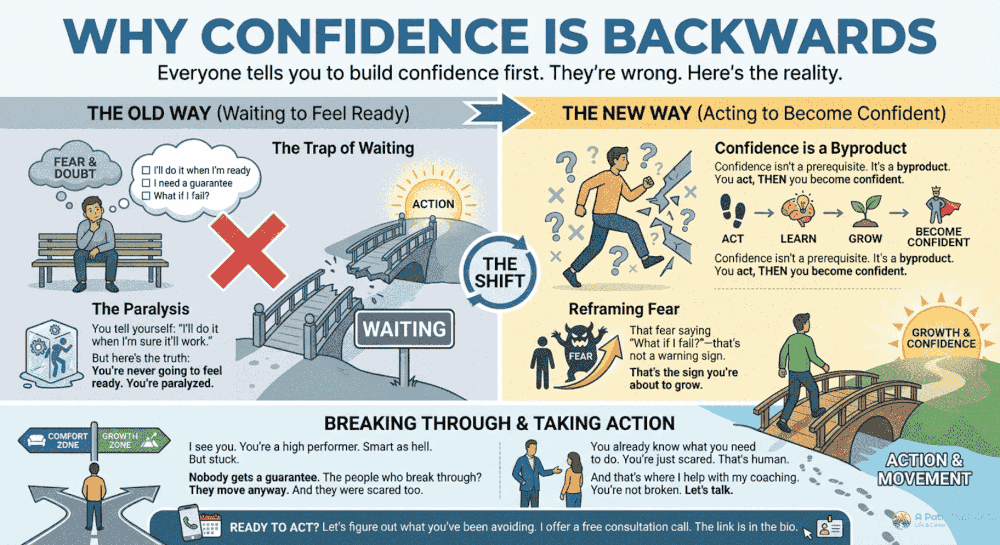
Action Is How Your Brain Updates the Draft
I worked with an mid-stage start-up director who'd been passed over for VP twice. She was waiting to "feel confident enough" to try again. The narrative she'd settled on: "I'm not VP material. They've proven it twice." We flipped it.
She started acting like someone who belonged in VP conversations: requesting skip-level meetings, proposing strategic initiatives, speaking up in leadership forums. Not pretending. Not faking it. Just taking the actions that matched the identity she wanted to grow into. Three months later, she wasn't waiting for confidence. The actions had built it. Eight months later, she had the VP title.
This is why my 4-Pillar Method starts with Discover, not positive thinking. You need to discover and see the old framework clearly before you can author a new one.
I think about the 7-year-old version of myself selling Air Jordans on a fake home shopping network I created. That kid wasn't confident because he succeeded. He was confident because he was telling himself a narrative: "I'm the kind of person who makes things happen." Somewhere between 7 and 37, most of us stop telling that version. Self confidence coaching is about finding it again.
My Narrative Reconsolidation Method: One Exercise That Changes Everything
I'm not going to give you four generic journaling prompts. Instead, I'm giving you the one exercise that's created the biggest breakthroughs with the professionals I coach.
I call this the Narrative Reconsolidation Method™ – and it's based on a simple neurological fact: your brain can only hold so much information, so it prioritizes emotionally charged memories and discards context. Which means your "failure story" is missing about 90% of what actually happened.
The Exercise
Take your most limiting memory. The firing, the rejection, the "proof" you're not enough. Write down the version you've been telling yourself. Get it all out.
Now write this heading: "What Else Was True in That Moment?" and list at least ten things your brain has conveniently forgotten.
When I got fired, what else was true?
I had skills that multiple companies had paid well for
I had a network of colleagues who respected my work
I had survived setbacks before and rebuilt
I had a spouse who believed in me when I didn't believe in myself
I had been unhappy in that role for months but too scared to leave
The company was going through massive layoffs (it wasn't personal)
Three former colleagues reached out within 24 hours to offer help
I had enough savings to take three months to figure out next steps
I had learned more in that role than in the previous three combined
My brain wanted to focus on one interpretation: "I failed." The full truth was bigger, more complex, and ultimately more empowering.
If you're doing this exercise right now and feeling resistance, anger, or the urge to argue with me – good. That's your old narrative fighting to stay alive. Keep writing anyway.
Self-affirmation research finds that reflecting on personally important values can reduce defensive reactions and increase openness to challenging information.(8) But more than that, the Narrative Reconsolidation Method teaches your brain that memories aren't facts, they're choices about what to remember.
The Follow-Up
After you've listed what else was true, write one sentence: "The story I've been telling myself is ____________. A more complete story is ____________."
For my firing:
Old story: "I failed and proved I'm not leadership material."
Complete story: "I was in a role that wasn't leveraging my strengths during a company-wide restructuring. That experience taught me what I don't want and clarified what I do."
Notice: the complete version doesn't erase what happened. It contextualizes it. It takes a chapter and stops letting it be the whole book.
Your brain prioritizes the emotionally charged parts and forgets the context. Your job is to add the context back. This work isn't easy. Rewriting a narrative you've told yourself for 10+ years takes practice. But intervention studies report that consistent cognitive reframing can begin to shift emotional patterns within a matter of weeks.(5) A few darn weeks! That's less time than you'll spend scrolling LinkedIn looking at jobs you're afraid to apply for.

Why Working with a Confidence Coach Accelerates the Process
You can do this work alone. But here's why most people don't: because the voice telling you the old internal script is your voice. It's hard to hear the lie when you're the one telling it.
Here's what a Phoenix confidence coach actually does: he catches the limiting scripts you can't hear anymore, asks questions that create cognitive dissonance with the old narrative, holds the new version steady while you practice believing it, and helps you design "action experiments" that give your brain evidence for the rewrite.
I worked with a Director of Operations who'd been fired 18 months earlier. She'd applied to 94 jobs (she literally had a spreadsheet tracking this!) Zero interviews. The mental model she was operating from: "I'm damaged goods. That firing proved I'm not leadership material."
Within five sessions, we rewrote it: "I was in a role that wasn't leveraging my strengths. That firing was feedback about the fit, not my worth. I'm looking for an organization that values what I actually do best."
But we didn't just reframe the narrative. We tested it through action experiments: reaching out to former colleagues, rewriting her LinkedIn to emphasize strengths instead of hiding gaps, applying to twenty carefully selected roles with strategic networking strategies instead of 94 desperate applications. Three months later: two job offers. She picked the one that felt like the story she wanted to tell.
That's not toxic positivity. She didn't ignore the firing. She just stopped letting one chapter define the whole book.

The Story You Need Might Be the One You Started With
I think about that 7-year-old version of myself a lot. Before anyone told me what "realistic" looked like. Before I learned to make myself smaller to fit other people's stories or mold myself to a version of success I thought I wanted (but was wrong).
That kid knew something I had to relearn: confidence isn't about having a perfect past. It's about being the author of what comes next.
You had a narrative once. Before the setbacks, the firings, the should-haves rewrote it. Before you learned to doubt yourself. That version is still there. It's just buried under years of revisions written by fear, disappointment, and other people's expectations.
The past doesn't exist anymore, except in your memory. And your memory? That's just a story. Stories can be rewritten. Professional confidence can be rebuilt. You can be the author again.
Ready to Transform Your Life? Start With a Free Consultation
The most successful people don't wait for perfect conditions—they take action when they recognize an opportunity. I work with people who are done living in someone else's story, the one about playing it safe, staying grateful, not rocking the boat.
The confidence you're looking for isn't out there somewhere. It's in the internal script you tell yourself about who you are and what's possible.
Take the first step today by scheduling a free 60-minute consultation call with coach Jeff.
This is a no obligation call to see if coaching is right for you! Your future self will thank you for taking this crucial step today.

Frequently Asked Questions:
What does a confidence coach do?
A confidence coach helps you stop living in someone else's story about who you should be. As a Phoenix confidence coach, I work with professionals to identify the limiting narratives from past setbacks—firings, rejections, failures that "proved" you weren't enough—and rewrite those stories using neuroscience-backed methods. Then we build real confidence through action experiments, not affirmations. You learn to be the author of your own story again.
How is confidence coaching different from therapy?
Therapy explores your past for healing and processing trauma. Confidence coaching uses your past to understand patterns, then focuses on action, identity, and future direction. It's forward-looking and centered on building skills, developing confidence, and creating career clarity. Think of it this way: Therapy asks "why do I feel this way?" Confidence coaching asks "what story am I telling myself, and how do I rewrite it?"
How does confidence coaching actually work?
Self confidence coaching works through structured exercises and "action experiments" that give your brain evidence you're capable. We identify the old mental scripts running your decisions, use my Narrative Reconsolidation Method to rewrite those stories with missing context, then test the new narrative through real-world actions. You might reach out to a former colleague, apply for a role you've been avoiding, or speak up in a meeting where you'd normally stay quiet. Confidence follows the reps, not the other way around.
What is the Narrative Reconsolidation Method?
The Narrative Reconsolidation Method is a coaching process I developed to help clients rewrite limiting stories from their past. It leverages neuroscience research on memory reconsolidation to reveal "what else was true" in moments you remember as failures. Your brain has been rewriting your memories for years—just not in your favor. This method teaches you to do it consciously, adding back the context your brain conveniently forgot, so a single chapter stops defining your whole story.
How long does it take to build confidence?
Research shows that consistent cognitive reframing can shift emotional patterns within 2-3 weeks. Most clients notice meaningful changes in how they think about themselves within the first month—less second-guessing, fewer spirals about past failures. Real, sustainable confidence, the kind that shows up in job interviews and leadership moments, typically develops over 3-6 months of consistent practice. It's not about waiting to "feel ready." It's about taking action despite uncertainty until your brain catches up.
Who is confidence coaching best for?
Confidence coaching is best for mid-career professionals who feel successful on paper but still doubt themselves. People experiencing imposter syndrome, replaying past career setbacks on a loop, or feeling held back by a firing or failure that "proved" something about their worth. I work primarily with Phoenix-area clients in tech, healthcare, and financial services—especially those navigating AI disruption, career transitions, burnout, or the gap between where they are and where they know they should be. You don't need to be broken. You just need to stop telling yourself a story that makes you smaller than you are.
Can confidence really be rebuilt after a career setback like getting fired?
Yes. Neuroscience shows that memories aren't video recordings—they're reconstructed every time you recall them. With the right tools, you can rewrite the meaning you gave to events like firings, layoffs, or missed promotions. I got fired from a previous role. My brain wanted to make that mean "I failed and I'm not leadership material." The fuller story? I was in a role that wasn't leveraging my strengths during a company-wide restructuring. That reframe changed everything. Your past setback is missing 90% of the context. Add it back, and you rebuild professional confidence.
Is confidence coaching worth it for career transitions?
Absolutely. Confidence influences everything: how you show up in job interviews, whether you apply for the promotion, your presence in leadership moments, how you network, and which risks you're willing to take. Without confidence, you stay stuck applying for roles beneath your capability or waiting for "perfect timing" that never comes. Coaching helps you show up as the version of yourself you want hiring managers and leaders to see—not the version haunted by past setbacks. Most of my clients land better roles, negotiate higher offers, or finally make the move they've been delaying for years.
How do I know if I need a confidence coach?
If you're qualified but hesitate to apply for promotions. If you replay past failures more than you celebrate wins. If Sunday night fills you with dread despite being "successful on paper." If you're waiting to "feel confident enough" before making a move. If a firing or rejection years ago still feels like proof you're not enough. If you know you're capable but can't seem to convince yourself. Those are signs that confidence coaching could help. You're not looking for someone to fix you. You're looking for someone to help you hear the limiting scripts you can't catch on your own.
What should I expect from working with a Phoenix confidence coach?
Expect to be uncomfortable. I'm not here to tell you everything will be fine or that you just need to "believe in yourself." I'm here to catch the lies you're telling yourself, ask questions that create cognitive dissonance with your old story, and hold the new narrative steady while you practice believing it. We'll design action experiments that give your brain evidence for the rewrite. You'll do hard things—reach out to people, apply for roles, have difficult conversations. Within three months, most clients stop waiting for confidence and start building it through action. Within six months, they've rewritten the story entirely.

I’m Jeff Rothenberg, a personal growth and career coach helping people turn uncertainty into confidence and clarity. Whether you’re rebuilding after change, exploring your next career move, or simply ready to grow, I’ll help you create momentum that lasts.
